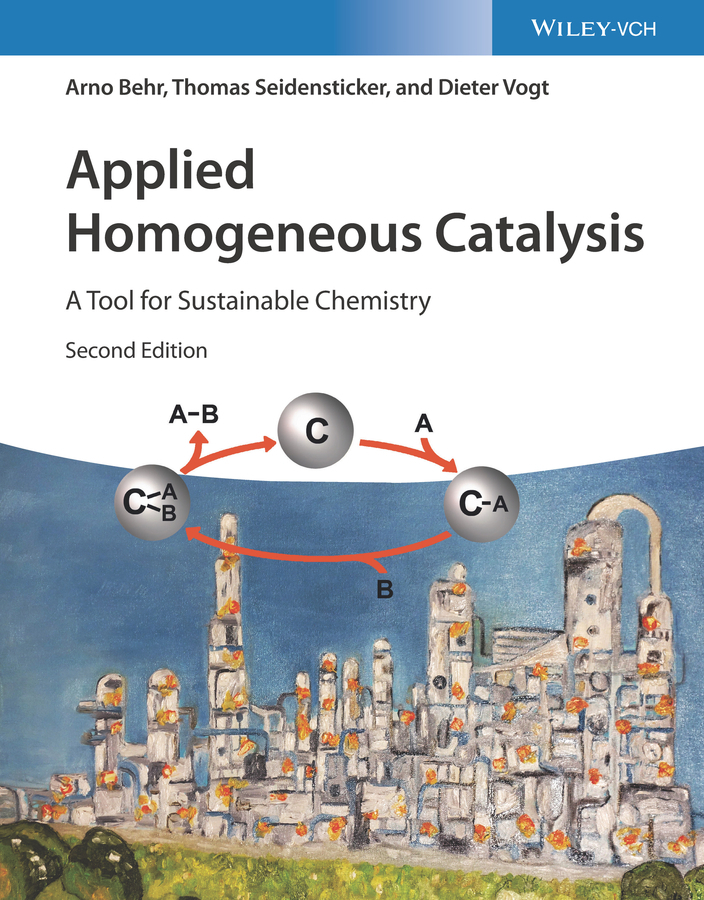
Applied Homogeneous Catalysis
A Tool for Sustainable Chemistry
Applied Homogeneous Catalysis
A Tool for Sustainable Chemistry
One of the key catalysis books for researchers, professionals in industry, and students, covering homogeneous catalysis from general concepts through detailed examples and industrial applications.
FOREWORD
FOREWORD
PREFACE
ABBREVIATIONS
INTRODUCTION:
Adhering to the 12 Principles of Green Chemistry: How Does Homogeneous Catalysis Contribute?
PART I: CHEMICAL BASICS
1. Definition, Variants and Examples: What Actually Is Catalysis?
2. A Brief History: Homogeneous Transition Metal Catalysis - A Young Science
3. Industrial Homogeneous Catalysis: What is the Economic Importance?
4. Definition of Important Terms: X, Y, S, STY, TON, TOF and more
5. Basics of Organometallic Chemistry: Bonds, Elementary Steps, and Mechanisms
6. Transition Metal Compounds: The "Captains" of Homogeneous Catalysis
7. Ligands: The "Helmsmen" of Homogeneous Catalysis
8. Solvents in Homogeneous Catalysis: The Reaction Medium
9. Enantioselective Catalysis: The "Special Case"
10. Thermodynamics of Homogeneous Catalysis: When Does a Chemical Reaction Run?
11. Kinetics of Homogeneous Catalysis: How Does the Reaction Proceed?
12. Overview of Spectroscopic Methods: Can We See into Homogeneous Catalysis?
PART II: PROCESS ENGINEERING FUNDAMENTALS
13. Reactor Types: Where Homogeneous Catalysis Actually Ooccurs
14. Overview of Catalyst Separation Techniques: How Catalyst and Product Go Their Separate Ways After the Reaction
15. Catalyst Separation by Membranes: A Barrier Between Products and Catalysts
16. Immobilisation on Solid Supports: From Homogeneity to Heterogeneity
17. Liquid-Liquid Multiphase Systems: The Smart Approach to Catalyst Separation
18. Switchable Multiphase Systems: Triggering Separation of Homogeneous Mixtures
19. Optimisation Strategies: Combinatorial Synthesis, Design of Experiments and High-Throughput Screening
20. Process Development in Miniplants: From Laboratory to Production
PART III: HOMOGENEOUSLY CATALYSED REACTION TYPES
21. An Overview of C-C-Bond Formation: A Guide Through the Jungle
22. Hydroformylation: The Industrial Route to Aldehydes and Alcohols
23. Carbonylations: The Versatile Insertions of Carbon Monoxide
24. Oligomerisation and Cyclo-Oligomerisation: The Conversion of Unsaturated Aliphatics into Short Chains or Medium-Sized Ring
25. Metathesis: A "Change-Your-Partners" Dance
26. Polymerisation: The Purposeful Assembly of Macromolecules
27. Telomerisation: The Construction of Functionalised Aliphatic Chains
28. Carbon-Carbon Coupling Reactions: Quite a lot of Name Reactions
29. Hydrogenation: C-H Bond Formation
30. Oxidation: C-O Bond Formation
31. Amination and Hydroamination: C-N Bond Formation
32. Hydrofunctionalisation: Formation of Further C-X Bonds
33. Isomerisation and Rearrangement: Migration of Double Bonds and Rearrangement of the Carbon Backbone
34. Tandem Reactions: Multiple Synthesis Steps in One Pot
PART IV: ASSOCIATED CATALYSIS
35. Nanocatalysis: A Balancing Act Between Homogeneous and Heterogeneous Catalysis
36. Electrocatalysis: Catalysis with Electrons
37. Photocatalysis: Catalysis with Photons
38. Alternative Ways of Energy Input: Sono-, Microwave- and Mechanocatalysis
39. Organocatalysis: Homogeneous Catalysis only with Organic Compounds
PART V: NEW RESOURCES
40. Alkane Activation: Acquisition of New Feedstocks
41. Reactions with Carbon Dioxide: Activating an "Inactive" Molecule
42. Nitrogen Activation: Reaching for the Air
43. Recycling of Polymers: The Use of Waste
44. Homogeneous Catalysis with Renewables: Using Nature's Treasures
45. Future Challenges of Homogeneous Catalysis: What the Crystal Ball Might Tell You
ANSWERS TO THE QUICKIES
INDEX
Login
Behr, Arno
Seidensticker, Thomas
Vogt, Dieter
| ISBN | 9783527351114 |
|---|---|
| Media type | Book |
| Edition number | 2. Aufl. |
| Copyright year | 2025 |
| Publisher | Wiley-VCH |
| Illustrations | 103 Farbabb., 74 Tabellen |
| Language | English |