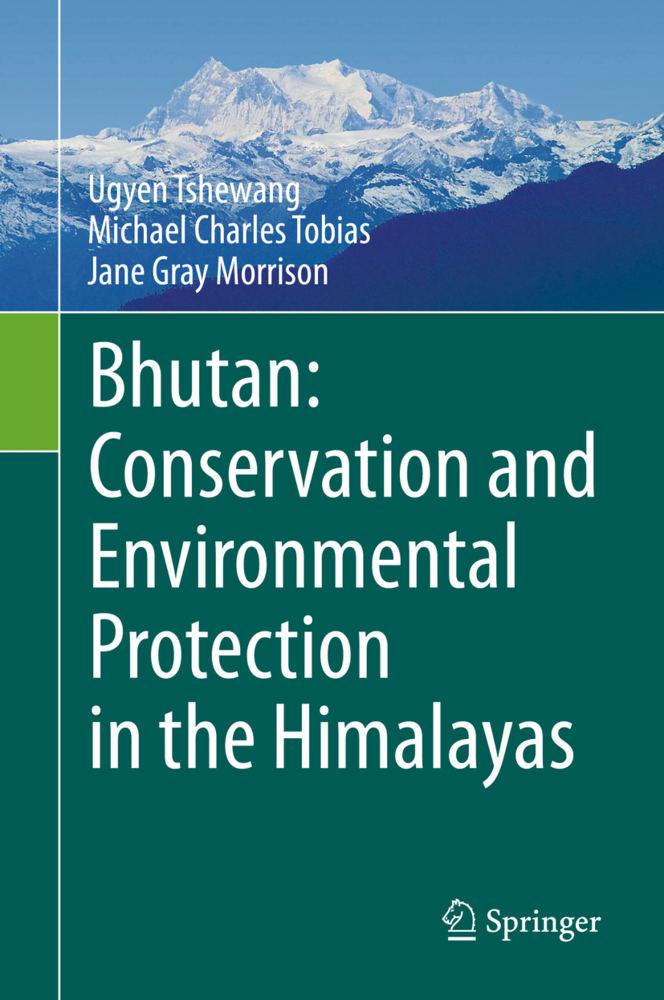
Bhutan: Conservation and Environmental Protection in the Himalayas
Bhutan: Conservation and Environmental Protection in the Himalayas
Located in the heart of the Eastern Himalayas, Bhutan practices the philosophy of Gross National Happiness ("GNH") that embraces environmental conservation as one of the main building blocks for its sustainable development goals. Bhutan's conservation strategies and success are largely driven by the strong political will and visionary leadership of His Majesty the King of Bhutan The nation's Buddhist perspectives regarding a deep and abiding respect for nature; and the strategic enforcement of a wide-ranging stringent set of internal regulations and controls have helped ensure ecological gold standards in Bhutan. Moreover, the country is an active member of the international conservation community by fulfilling its implementation of various Multilateral Environment Agreements. While it emerged into the 21st century as one of the 36 global terrestrial "hotspots" in biological diversity conservation ranks, Bhutan's sheer commitment with more than 51% of its territory being managed under the explicit status of a protected area network, and more than 70% of the land under forest cover, represents Bhutan's exemplary dedication to protect the planet despite its smallness in size and economy, and the biological fragility exemplified by its hotspot situation. In the face of imminent severe threats of global warming, Bhutan nonetheless exemplifies the truth that "a small country with a big conservation commitment" can make an enormous contribution to the global community.
At the regional level, Bhutan is intent upon protecting the Water Towers of Asia (that glacial expanse of the Himalayas) which is a critical resource bulwark for about one-fifth of the global population downstream in South Asia. Such protections invariably help mitigate climate change by acting as a nation-wide carbon sink through its carbon neutral policies. In short, Bhutan has long represented one of the world's foremost national guardians of biodiversity conservation, ecological good governance, and societal sustainability at a period when the world has entered the Anthropocene - an epoch of mass extinctions.
We envision this publication to be ecologically and ethically provocative and revealing for the concerned scientific communities, and governments. Through an extensive review of the scientific and anthropological literature, as well as the research team's own data, the Author's have set forth timely recommendations for conservation policies, strategies and actions. This book provides technical and deeply considered assessments of the state of Bhutan's environment, its multiple, human-induced stressors and pressures; as well as extremely sound, practical techniques that would address conservation strategies in the Himalayas and, by implication, worldwide.
CHAPTER 1. STATE OF ENVIRONMENT IN BHUTAN
Abstract
Overview of Bhutan.-Ecological Zones & Climatic Features
Land Use in Bhutan
Source: FRMD/DOFPS. Conservation Efforts & Protected Area Systems
Conservation Laws and Policies. Assessment of Non-Protected Areas
Sustainable Forest Management Plans in Non-protected Area. Scientific Forest Management
Community Forest Empowerment. Non-Wood Forest Product (NWFP) Management. Plantation and Reforestation Programs. Keystone species and Conservation Areas. Foot Notes
Annexure 1..1 Classification and Characteristics of Vegetation Zones in Bhutan (Grierson & Long, 1983, see 19)
Annexure 1.2 Description of Classification of Land Cover Class and Sub-Class in Bhutan (See 20)
CHAPTER 2
DRIVERS AND PRESSURE ON THE STATE OF ENVIRONMENT IN BHUTAN. Abstract
Land Use.-Hydropower projects
Farm Roads
Mining and Mineral Development
Land use for Agriculture
Waste Management
CHAPTER 3
NON-VIOLENT TECHNIQUESFOR HUMAN-WILDLIFE CONFLICT RESOLUTION
Abstract
Contextual Framework within the ACPB
Methodology
Global context of HWC
Conflict Management Strategies.-Retaliatory Actions and Violent Approaches
Lethal Control - Counterproductive 96
From Conflict to Co-existence
Safe and Non-Violent Approach
Table 3.1 Important Elements of HWC (WWF-Bhutan, 2016; See Foot Note 78)
Human Wildlife Conflict Policy
Implementing Agencies for HWC. Immune-contraception for population control
Translocation of Problem Animals
Alternative Livelihoods
Land-Use Planning and Landscape Management
Mitigation Measures
Compensation
Performance payments
Ecotourism and Revenue Sharing
Community Education
Understanding the Conflict Profile
Reporting.-Information compilation, management and use
Response - measures taken to alleviate a specific or ongoing HWC incident
Monitoring and Evaluation - measuring the performance of HWC management
Human Wildlife Conflict Situation inBhutan
Underlying Forces of Human Wild-life Conflicts in Bhutan
Human Wildlife Conflict Situation in Bhutan
Preventive Measures
Mitigation Approach in Bhutan
Strategic Outcomes
Table 3.5 Strategic Intents contributing to the Safe System (WWF-Bhutan, 2016; See Foot Note 246)
Effective Monitoring and Evaluation
Conclusion and Recommendation
Non-violent and Safe Approach
Institutional Arrangement
Human Wildlife Conflict Policy & Legislation
Coping Techniques and Mechanisms
Hotspot Mapping
Physiological Sterilization of wildlife
Table 3.6 Immunocontraceptive vaccines used in different animals
Innovative Research Fund for farmers
Economic Responses to HWC
Alternative livelihoods
Regional Transboundary Conservation
Foot Notes
Annexure 3.1 Indicators of the Strategic Outcomes of People, Wildlife, Assets and Habitat
CHAPTER 4.- ANIMAL RIGHTS AND PROTECTION.-Abstract
Buddhist Perspectives & Conservation Biology
Bhutanese Buddhism and the Segue To Contemporary Animal Protection Policies
National Law & Buddhist Ethics
State Monastic Body
Non-governmental Organizations (NGO)
Tshethar (Life Saving) Practices
Animal Health and Rescue Centers
Farming Systems and Livestock Population
Meat Consumption in Bhutan
Discussion and Recommendations on Animal Protection and Animal Rights
Animal Protection Policy of Bhutan
Population control of Livestock Animals
Institutionalization and Implementation Arrangement
Monitoring & Implementation
Dog Population Control
GNH Index for Animal Kingdom
References (1-125)
Annexure 4.1 God's Country: The New Zealand Factor, by Michael Charles Tobias and Jane Gray Morrison, Dancing Star Foundation, 2010
CHAPTER 5. GAP ANALYSIS OF THREATENED, RARE AND UNDER-REPRESENTED SPECIES IN BHUTAN
Abstract
Introduction
Impacts of Extinction of Species
Taxonomic Classification - Seven Kingdoms Model
Objectives
Methodology
Assessment of Under-Represented
Login
Tshewang, Ugyen
Tobias, Michael Charles
Morrison, Jane Gray
| ISBN | 978-3-030-57826-8 |
|---|---|
| Media type | Book |
| Copyright year | 2022 |
| Publisher | Springer, Berlin |
| Length | LX, 353 pages |
| Illustrations | LX, 353 p. 181 illus., 155 illus. in color. |
| Language | English |