
Cognitive Economics
An Interdisciplinary Approach
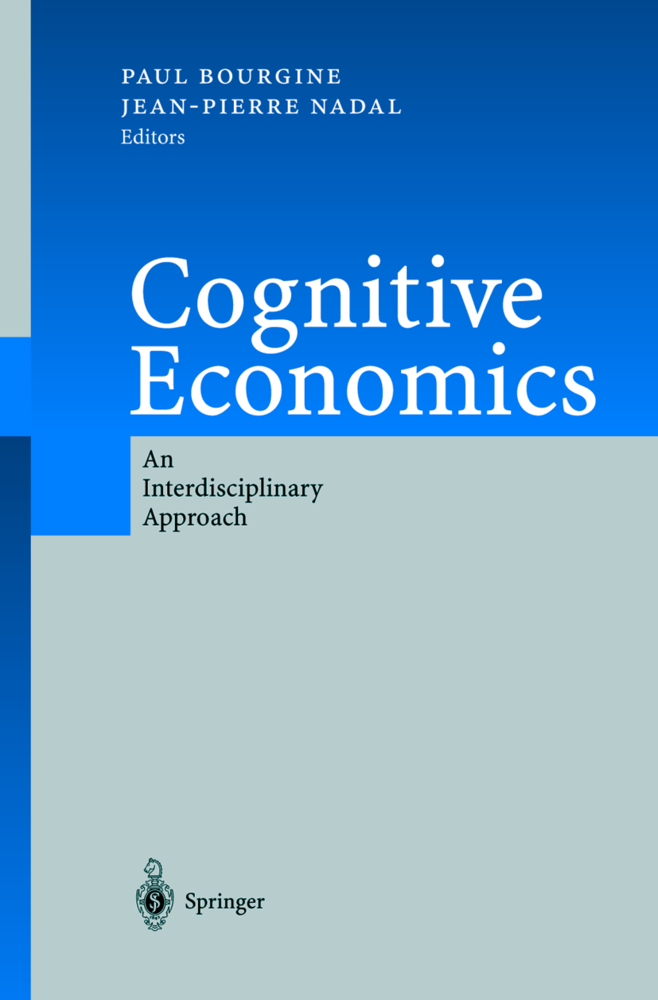
Cognitive Economics
An Interdisciplinary Approach
The social sciences study knowing subjects and their interactions. A "cog nitive turn", based on cognitive science, has the potential to enrich these sciences considerably. Cognitive economics belongs within this movement of the social sciences. It aims to take into account the cognitive processes of individuals in economic theory, both on the level of the agent and on the level of their dynamic interactions and the resulting collective phenomena. This is an ambitious research programme that aims to link two levels of com plexity: the level of cognitive phenomena as studied and tested by cognitive science, and the level of collective phenomena produced by the economic in teractions between agents. Such an objective requires cooperation, not only between economists and cognitive scientists but also with mathematicians, physicists and computer scientists, in order to renew, study and simulate models of dynamical systems involving economic agents and their cognitive mechanisms. The hard core of classical economics is the General Equilibrium Theory, based on the optimising rationality of the agent and on static concepts of equilibrium, following a point of view systemised in the framework of Game Theory. The agent is considered "rational" if everything takes place as if he was maximising a function representing his preferences, his utility function.
3 General Equilibrium
4 The Principles of Game Theory
5 Rationality and the Experimental Study of Reasoning
6 Supraclassical Inference without Probability
7 From Natural to Artificial Intelligence: Numerical Processing for Cognitive Tasks
8 An Introduction to Statistical Mechanics
9 Spontaneous Symmetry Breaking and the Transition to Disorder in Physics
10 Co-Evolutionist Stochastic Dynamics: Emergence of Power Laws
11 Topics of Cognitive Economics
12 What is a Collective Belief?
13 Conditional Statements and Directives
14 Choice Axioms for a Positive Value of Information
15 Elements of Viability Theory for the Analysis of Dynamic Economics
16 Stochastic Evolutionary Game Theory
17 The Evolutionary Analysis of Signal Games
18 The Structure of Economic Interaction: Individual and Collective Rationality
19 Experimental Markets: Empirical Data for Theorists
20 Social Interactions in Economic Theory: An Insight from Statistical Mechanics
21 Adjustment and Social Choice
22 From Agent-based Computational Economics Towards Cognitive Economics
23 Social Networks and Economic Dynamics
24 Coalitions and Networks in Economic Analysis
25 Threshold Phenomena versus Killer Clusters in Bimodal Competion for Standards
26 Cognitive Efficiency of Social Networks Providing Consumption Advice on Experience Goods
The Future of Cognitive Economics.
1 What is Cognitive Economics?
2 Rational Choice under Uncertainty3 General Equilibrium
4 The Principles of Game Theory
5 Rationality and the Experimental Study of Reasoning
6 Supraclassical Inference without Probability
7 From Natural to Artificial Intelligence: Numerical Processing for Cognitive Tasks
8 An Introduction to Statistical Mechanics
9 Spontaneous Symmetry Breaking and the Transition to Disorder in Physics
10 Co-Evolutionist Stochastic Dynamics: Emergence of Power Laws
11 Topics of Cognitive Economics
12 What is a Collective Belief?
13 Conditional Statements and Directives
14 Choice Axioms for a Positive Value of Information
15 Elements of Viability Theory for the Analysis of Dynamic Economics
16 Stochastic Evolutionary Game Theory
17 The Evolutionary Analysis of Signal Games
18 The Structure of Economic Interaction: Individual and Collective Rationality
19 Experimental Markets: Empirical Data for Theorists
20 Social Interactions in Economic Theory: An Insight from Statistical Mechanics
21 Adjustment and Social Choice
22 From Agent-based Computational Economics Towards Cognitive Economics
23 Social Networks and Economic Dynamics
24 Coalitions and Networks in Economic Analysis
25 Threshold Phenomena versus Killer Clusters in Bimodal Competion for Standards
26 Cognitive Efficiency of Social Networks Providing Consumption Advice on Experience Goods
The Future of Cognitive Economics.
Login
| ISBN | 978-3-540-40468-2 |
|---|---|
| Media type | Book |
| Copyright year | 2004 |
| Publisher | Springer, Berlin |
| Length | XIV, 479 pages |
| Illustrations | XIV, 479 p. |
| Language | English |