Molecular Nanographenes
Synthesis, Properties, and Applications
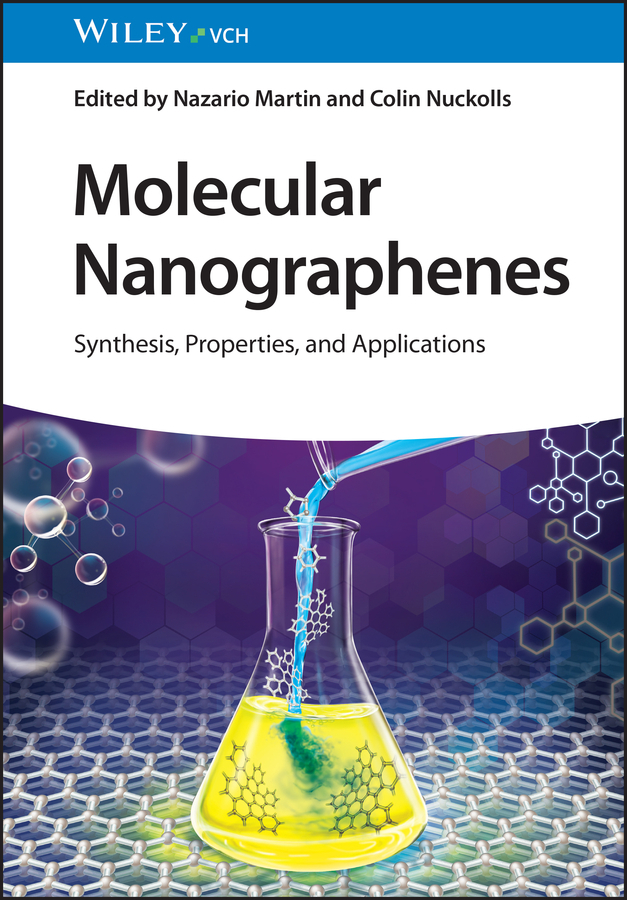
Molecular Nanographenes
Synthesis, Properties, and Applications
Explore the world?s most powerful materials with nanographene research
Graphene, comprised of a single layer of carbon atoms in a honeycomb nanostructural arrangement, is the thinnest and strongest material yet known to science. Despite that this pristine carbon allotrope exhibits a variety of outstanding properties, its zero bandgap prevents its use for some optoelectronic applications. Fragments of graphene, or nanographenes, have shown a great potential to obviate these problems, thus paving the way for the development of chiroptical and optoelectronic properties.
Molecular Nanographenes constitutes a comprehensive overview on the synthesis of these materials and their properties. Covering their widely varying morphologies, their potential applications, and their valuable chiroptical and photophysical features, it also analyzes multiple approaches to obtain nanographene by using both top-down and bottom-up methodologies. The result is a one-stop shop for materials scientists and other researchers interested in these emergent and fascinating materials.
Molecular Nanographenes readers will also find:
* A careful distinction between top-down and bottom-up approaches to nanographene synthesis
* Detailed discussion of nanographene configurations including planar, bilayer, helical, nanobelt, and many other geometries
* An authorial team with pioneering research experience in the study of nano-sized graphenes and their synthesis
Molecular Nanographenes is ideal for materials scientists, polymer chemists, solid state chemists, organic chemists, and any other researchers looking to work with shape and size-controlled flakes of graphenes.
Fundamental Concepts in Nanographenes
Graphene, comprised of a single layer of carbon atoms in a honeycomb nanostructural arrangement, is the thinnest and strongest material yet known to science. Despite that this pristine carbon allotrope exhibits a variety of outstanding properties, its zero bandgap prevents its use for some optoelectronic applications. Fragments of graphene, or nanographenes, have shown a great potential to obviate these problems, thus paving the way for the development of chiroptical and optoelectronic properties.
Molecular Nanographenes constitutes a comprehensive overview on the synthesis of these materials and their properties. Covering their widely varying morphologies, their potential applications, and their valuable chiroptical and photophysical features, it also analyzes multiple approaches to obtain nanographene by using both top-down and bottom-up methodologies. The result is a one-stop shop for materials scientists and other researchers interested in these emergent and fascinating materials.
Molecular Nanographenes readers will also find:
* A careful distinction between top-down and bottom-up approaches to nanographene synthesis
* Detailed discussion of nanographene configurations including planar, bilayer, helical, nanobelt, and many other geometries
* An authorial team with pioneering research experience in the study of nano-sized graphenes and their synthesis
Molecular Nanographenes is ideal for materials scientists, polymer chemists, solid state chemists, organic chemists, and any other researchers looking to work with shape and size-controlled flakes of graphenes.
Fundamental Concepts in Nanographenes
1. Aromaticity and Antiaromaticity in Nanographenes: An Overview
2. Covalent Patterned Functionalization of Graphene
3. Nanographenes by Bottom-up Approach: The Scholl Reaction
4. Racemization barriers in chiral molecular nanographenes
Synthesis of Molecular Nanographenes
5. Synthesis of Helicenes
6. Carbon Nanobelts
7. Negatively Curved Nanographenes
8. Highly-strained Cyclophanes and other Nanographenes
9. Chiral Bilayer Nanographenes: Synthesis and Properties
10. Large p-Extended Carbon Nanorings: From Synthesis to Properties
11. Nanographenes with Multiple Zigzag Edges
12. Monkey Saddles and other Contorted Polycyclic Aromatic Compounds
13. Conjugated Nanohoops: Synthesis, Properties and Applications
14. Synthesis of Graphene Nanoribbons, Nanographenes and Fused Aromatic Networks Through the Formation of Pyrazine Rings
15. On-surface Synthesis of p-conjugated polymers
16. Merging organic chemistry with surface synthesis for the preparation of nanographenes
Properties and Applications of Molecular Nanographenes
17. Chiral Materials from Perylene Diimide Building Blocks: Twistacenes and Helicenes
18. Circularly Polarized Luminescence (CPL) in Nanographenes
19. Open-shell Nanographenes
20. Kekulé and Non-Kekulé Nanographenes: A Magnetic Perspective
21. Redox Properties of Nanographenes
Login
| ISBN | 9783527353224 |
|---|---|
| Media type | Book |
| Edition number | 1. Auflage |
| Copyright year | 2025 |
| Publisher | Wiley-VCH |
| Illustrations | 1 Tabellen |
| Language | English |