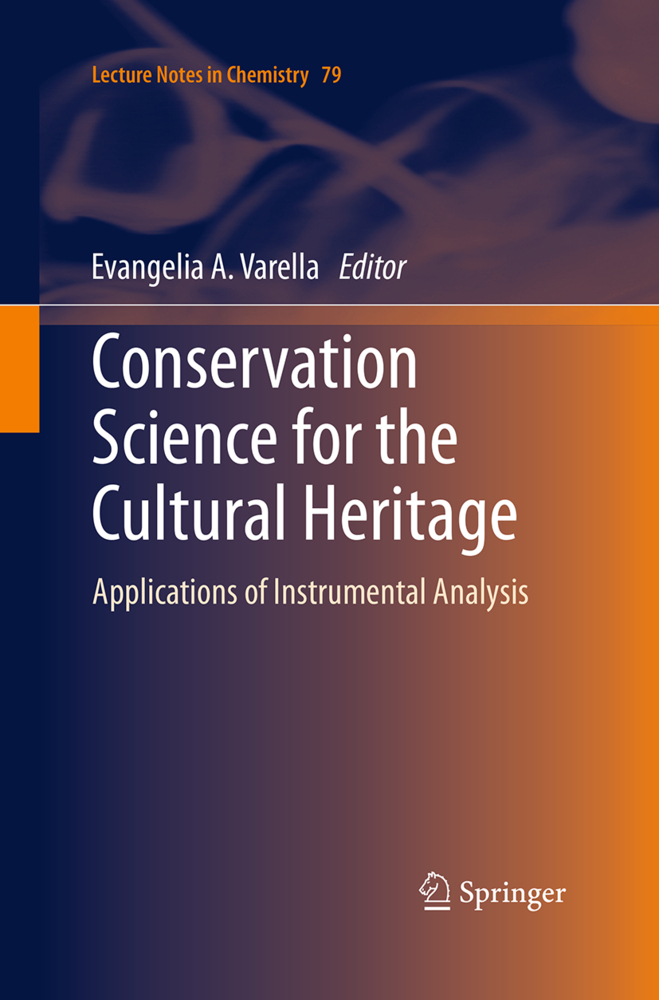
Conservation Science for the Cultural Heritage
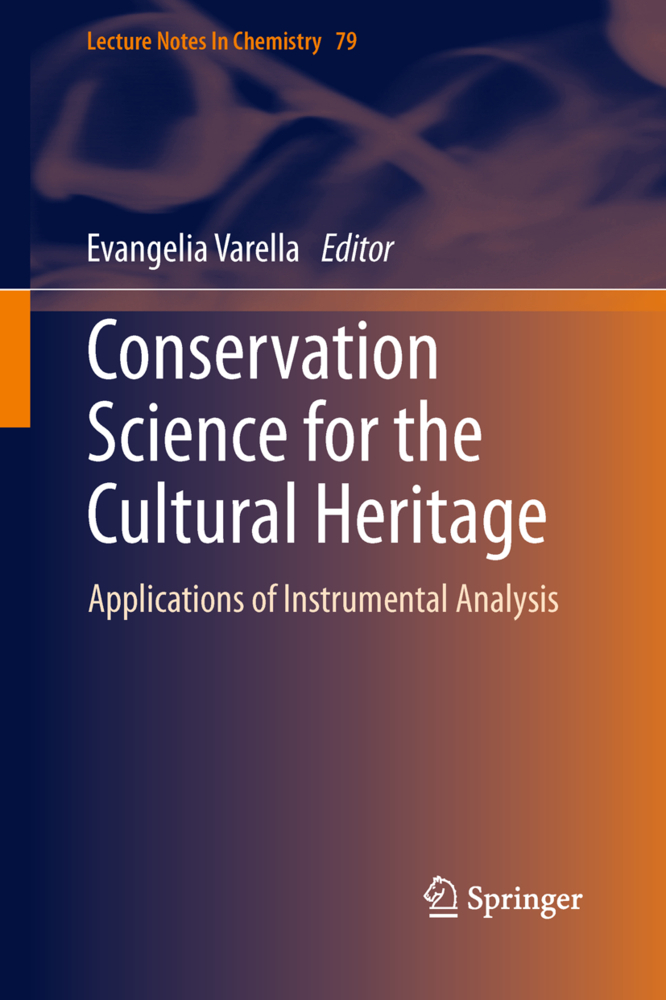
This volume allows to gain solid knowledge and improved skills on the ways separation schemes and diagnostic methodologies are applied in the safeguarding and authentication of tangible works of art; as well as on the modes of implementing novel safeguarding practices built on well-established principles - such as the use of laser in the decontamination of objects. All techniques are covered at a state-of-the-art level; while selected applications permit addressing major groups of materials and artefacts.
Conservation Science is nowadays taught at master's level in all developed countries, and museum laboratories increasingly adopt scientific approaches in their restoration initiatives. The book is intended as a valuable tool for students and professionals active in these frames. In addition, it provides an indispensable manual for participants in the specialized intensive courses, which are systematically offered by the authors under the auspices of the relevant European network.
General Considerations: On materials and artefacts
Separation Techniques: High Performance Liquid Chromatography (HPLC) and Gas Chromatography (GC)
Capillary Electrophoresis
Identification Techniques I: Imagine techniques
The role of microscopy techniques in the study of cultural heritage materials
Infrared and Raman Spectroscopy
Solid state NMR
Identification Techniques II: X-ray techniques and X-ray fluorescence with portable systems
The Small Angle Scattering technique: an effective tool in the structural investigation of archaeologically relevant specimens
Energy dispersive X-ray diffraction in cultural heritage science: The winning duo of structural and elemental analysis
Particle induced X-ray emission spectroscopy in conservation science
Atomic absorption spectroscopy in conservation science
Thermal analysis techniques
Applying the Techniques on Materials I: Identification of natural dyes in 13th Century textiles by HPLC-DAD detection
Identification of natural dyes by RP-HPLC-DAD and natural dyeing procedures
Liquid chromatographic analysis of ancient Egyptian organic material
Binding media identification in art objects by gas chromatography-mass spectrometry
FT Infrared Spectroscopy as an identification tool in polychrome artefact studies
Solid state NMR to characterize paper and parchment samples from a 16th century book
Case studies on textile studies with Scanning Electron Microscopy
Physicochemical methods of analysis for the study of archaeological textiles
Identification of purple by means of Pyrolysis Gas Chromatography /Mass Spectrometry
Applying the Techniques on Materials II: The application of back-scattered scanning electron microscopy to unravel building stone decay mechanisms in urban environments
Application of microscopy, X-ray diffractometry (XRD) and stable-isotope geochemistry in provenance determination ofthe white marbles used in the ancient Great Theatre of Larisa, Thessaly, Greece
Case studies: Investigation of mortars by Infrared and Raman Spectroscopy
Mortars-Thermal analysis
Electrochemical Impedance Spectroscopy measurements for the corrosion behaviour evaluation of epoxy - (organo) clays nanocomposite coatings
Study of Vatican masterpieces
Laser applications in cultural heritage preservation.
Varella, Evangelia A.
| ISBN | 978-3-642-30984-7 |
|---|---|
| Media type | Book |
| Copyright year | 2012 |
| Publisher | Springer, Berlin |
| Length | X, 334 pages |
| Illustrations | X, 334 p. |
| Language | English |