Methods to Study Litter Decomposition
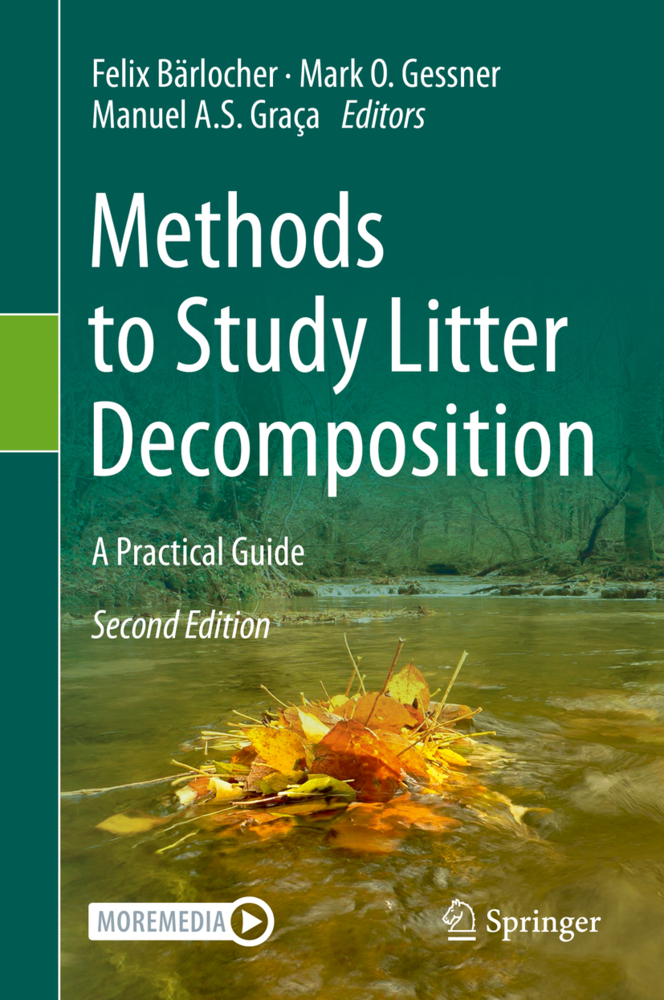
This edited volume is an extensive collection of methods for investigating plant litter dynamics in ecosystems. Particular emphasis is placed on litter decomposition in streams and rivers. The presented methods range from analyses of chemical and physical litter properties to the taxonomic and functional characterization of microbial decomposers, both fungi and bacteria, assessments of litter-consuming invertebrates, and procedures to determine litter dynamics at the stream ecosystem level. Several chapters addressing general topics of data analysis are also included.
This second edition of the book has been greatly expanded. Its now 63 chapters cover both well-established and recently elaborated techniques, some of which have not yet been applied to decomposing litter in streams. Modern molecular techniques ranging from next-generation sequencing to proteomics receive special attention among the 20 chapters that are entirely new. Numerous methods on characterizing litter consumers have also been added to fill an evident gap of the first edition. However, the basic original concept and all of the previous chapters have been retained, although most of them have been thoroughly updated.
Typical contributions provide step-by-step protocols that are preceded by brief reviews of the ecological significance and the principles underlying the method. Where available, short compilations of published data have been added in overview tables to provide background information on the range of results to expect. Useful hints, a discussion of potential weaknesses, and key references are provided at the end. Hands-on material useful to implement several of the presented methods (e.g. computer code, calculation sheets) is available online.
The book is written for students embarking on studies of plant litter dynamics and for established researchers wishing to expand the scope of their methodological toolbox to study litter decomposition and themicrobial decomposers and invertebrates involved in the process. The primary intended audience is aquatic ecologists, since many of the methods presented in the book focus on streams and stream organisms. However, the great majority of the protocols can be easily adapted or even directly applied to coastal and terrestrial ecosystems. Consequently, they should be of equal interest to scientists investigating plant litter dynamics in habitats such as mangroves and salt-marshes, terrestrial grasslands and forests.
Part 1. Litter dynamics: chapter 1. Litter Input (Arturo Elosegi & Jesús Pozo)
Chapter 2. Leaf Retention (Arturo Elosegi)chapter 3. Manipulating Litter Retention in Streams (Michael Dobson)
chapter 4. Coarse Benthic Organic Matter (Jesús Pozo & Arturo Elosegi)
chapter5. Leaching (Felix Bärlocher)
Chapter 6. Leaf Mass Loss Estimated by the Litter-Bag Technique (Felix Bärlocher)
Chapter7. Determining Litter Mass Loss by the Plant Tagging Approach (Kevin A. Kuehn & Mark O. Gessner)
Chapter 8. Wood Decomposition (Arturo Elosegi, Maite Arroita & Libe Solagaistua)
Chapter9. Decomposition of Fine Particulate Organic Matter (Yoshimura Chihiro)
Chapter10. Coarse Particulate Organic Matter Budgets (Jesús Pozo & Jon Molinero).- Part 2. Chemical and Physical Leaf Properties. Chapter11. Total Phosphorus, Nitrogen, and Carbon in Leaf Litter (Mogens R. Flindt, Ana I. Lillebø, Javier Pérez & Verónica Ferreira)
Chapter12. Total Protein (Mark O. Baerlocher)
Chapter13. Free Amino Acids (Shawn D. Mansfield & Mark O. Baerlocher)
chapter14. Determination of Total Carbohydrates (Shawn D. Mansfield)
chapter15. Determination of Soluble Carbohydrates (Letitia da Ros, Faride Unda, Shawn D. Mansfield)
Chapter16. Total Lipids (Mark O. Gessner & Paul T. M. Neumann)
Chapter17. Polyunsaturated Fatty Acids in Decomposing Leaf Litter (Eric Von Elert)
Chapter18. Total Phenolics (Felix Bärlocher & Manuel A.S. Graça)
Chapter19. Radial Diffusion Assay for Tannins (Manuel A.S. Graça & Felix Bärlocher)
Chapter20. Acid Butanol Assay to Determine Bulk Concentrations of Condensed Tannins (Mark O. Gessner & Daniel Steiner)
Chapter21. Lignin and Cellulose (Mark O. Gessner)
Chapter22. Physical Litter Properties: Leaf Toughness and Tensile Strength (Manuel A.S. Graça & Martin Zimmer).- Part 3. Microbial Decomposers. Chapter23. Techniques for Handling Ingoldian Fungi (Enrique Descals)
Chapter24. Maintenance of Aquatic Hyphomycete Cultures (Ludmila Marvanová)
Chapter 25. An Illustrated Key to the Common Temperate Species of Aquatic Hyphomycetes (Vladislav Gulis, Ludmila Marvanová & Enrique Descals)
Chapter26. Sporulation by Aquatic Hyphomycetes (Felix Bärlocher)
Chapter 27. Ergosterol as a Measure of Fungal Biomass (Mark O. Gessner)
Chapter 28. Fungal Growth Rates and Production (Keller Suberkropp, Mark O. Gessner & Kevin A. Kuehn)
Chapter 29. Bacterial Abundance and Biomass Determination in Plant Litter by Epifluorescence Microscopy (Nanna Buesing & Mark O. Gessner)
Chapter 30. Growth and Production of Litter-Associated Bacteria (Nanna Buesing, Mark O. Gessner & Kevin A. Kuehn)
Chapter 31. Isolation of Cellulose-Degrading Bacteria (Jürgen Marxsen)
Chapter 32. ATP as a Measure of Microbial Biomass(Manuela Abelho)
Chapter 33. Respiration of Litter-Associated Microbes and Invertebrates (Manuel A.S. Graça & Manuela Abelho).- Part 4. Molecular Microbial Community Analyses. Chapter34. Terminal Restriction Fragment Length Polymorphism (T-Rflp) to Estimate Fungal Diversity (Liliya G. Nikolcheva & Felix Bärlocher)
Chapter 35. Denaturing Gradient Gel Electrophoresis (DGGE) to Estimate Fungal Diversity (Liliya G. Nikolcheva & Felix Bärlocher)
Chapter36. Quantitative Real-Time PCR (qPCR) to Estimate Molecular Fungal Abundance (Christiane Baschien & J. Steffen C. Carl)
Chapter 37. Metabarcoding of Litter-associated Fungi and Bacteria (Sofia Duarte, Christian Wurzbacher & Sahadevan Seena)
Chapter 38. Identifying Active Members of Litter Fungal Communities by Precursor rRNA (Martina Stursová & Petr Baldrian)
Chapter 39. Gene Expression Analysis of Litter-Associated Fungi UsingRN
Login
Bärlocher, Felix
Gessner, Mark O.
Graça, Manuel A.S.
| ISBN | 978-3-030-30514-7 |
|---|---|
| Media type | Book |
| Edition number | 2. Aufl. |
| Copyright year | 2020 |
| Publisher | Springer, Berlin |
| Length | XXV, 604 pages |
| Illustrations | XXV, 604 p. 89 illus., 37 illus. in color. |
| Language | English |