Photopolymerizable Porous Polyorganophosphazenes
Degradable Matrices for Tissue Engineering
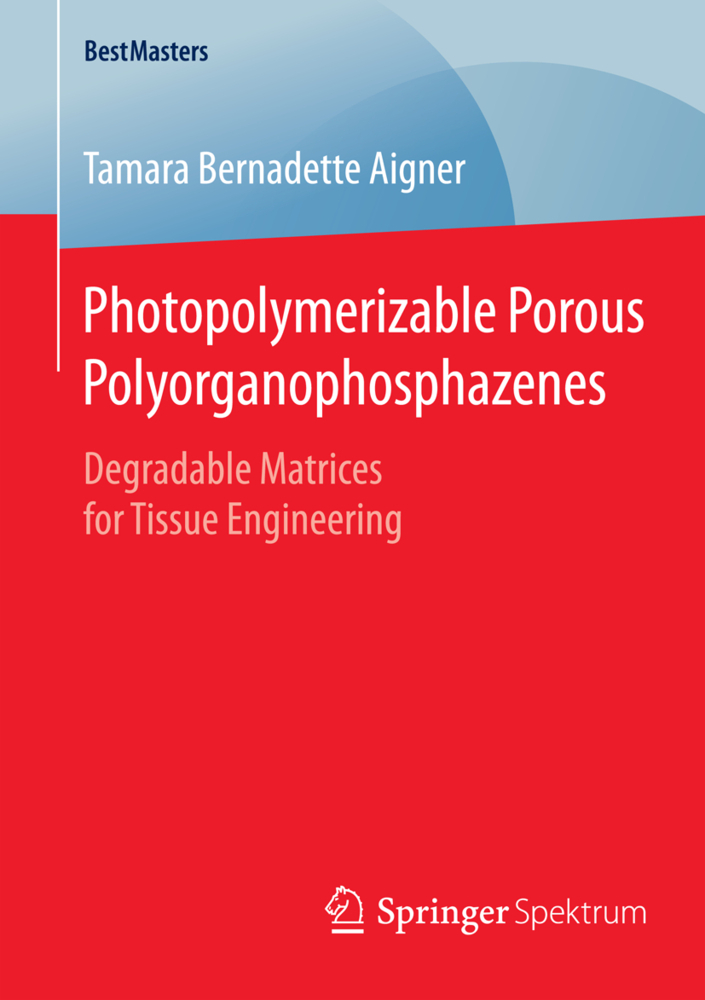
Photopolymerizable Porous Polyorganophosphazenes
Degradable Matrices for Tissue Engineering
Tamara Bernadette Aigner designed a set of biocompatible and biodegradable poly(organophosphazenes). In order to tailor their biological and chemical properties, she further modified these macromolecules by adding functional moieties via thiol-ene chemistry. The author used the same photochemistry for crosslinking to obtain a mechanically stable network. She further altered the degradation rate of the matrix as well as the mechanical properties by adding blending agents and created a porous matrix, which is necessary for cell invasion and communication, by a newly developed photocrosslinking particulate-leaching method. Thus, a modular hybrid system was established which is able to adapt to different microenvironments based upon tissue type.
Matrix Formation Using a Photocrosslinking Particulate-Leaching Technique
Tailored Physical and Biochemical Properties by Blending.
Polyphosphazenes as Biocompatible and Biodegradable Polymers
Functionalization and Crosslinking with Thiol-ene ChemistryMatrix Formation Using a Photocrosslinking Particulate-Leaching Technique
Tailored Physical and Biochemical Properties by Blending.
Login
Aigner, Tamara Bernadette
| ISBN | 978-3-658-09319-8 |
|---|---|
| Media type | Book |
| Copyright year | 2015 |
| Publisher | Springer, Berlin |
| Length | XIX, 75 pages |
| Illustrations | XIX, 75 p. 63 illus. |
| Language | English |