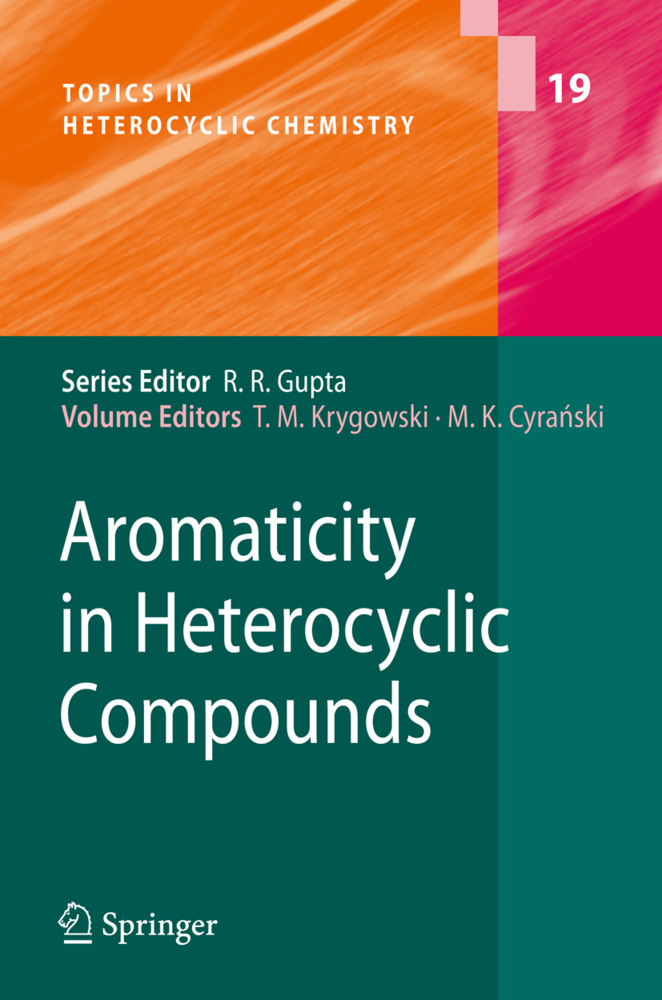
Aromaticity in Heterocyclic Compounds
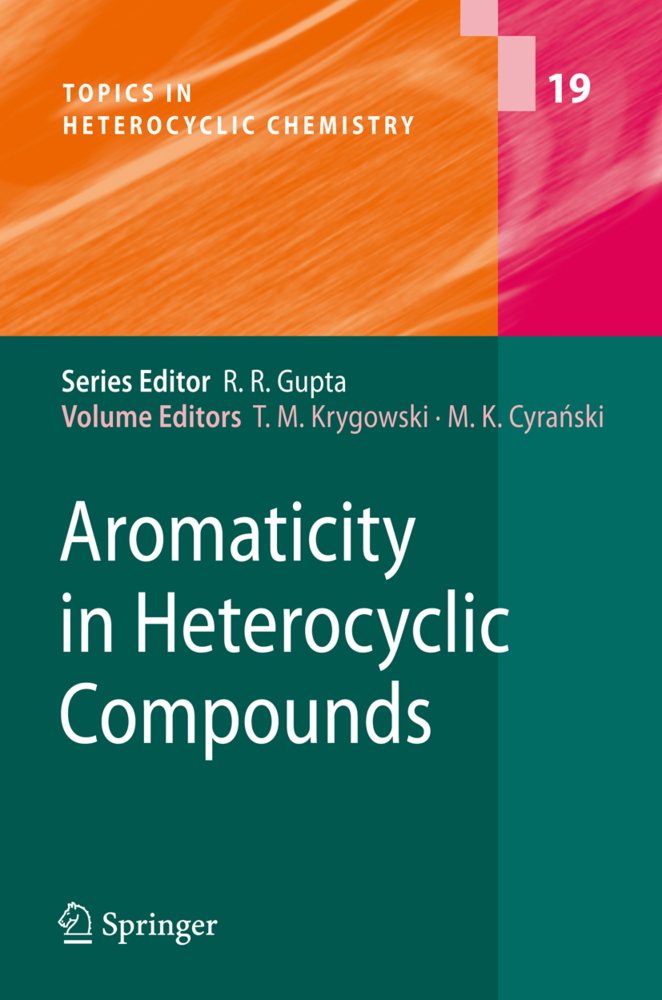
Aromaticity in Heterocyclic Compounds
Aromaticity is a notion that appeared in the mid-nineteenth century to differentiate between unsaturated hydrocarbons and formally unsaturated benzene [1-3]. At the end of the nineteenth century it seemed that cyclicity was a necessary condition for differentiation between the two, but at the beginning of the twentieth century it turned out that the above assumption was not correct because cyclooctatetraene exhibited typical properties known for polyenes [4]. The essential property of b- zene-like compounds, often identified with aromatic compounds, was low react- ity. Hence thermodynamic stability was defined as resonance energy [5, 6] and was the first quantitative measure of aromaticity. Many theoretical approaches were proposed later to estimate this quantity, and now the criterion is often considered to be the most fundamental [7]. Almost at the same time, magnetic susceptibility was used to describe aromaticity [8, 9]. Consequently, many concepts based on mag- tism were developed, probably the most effective in assessment of aromaticity being nucleus independent chemical shift (NICS) [10] or Fowler's maps of ring currents [11]. The criterion served Schleyer as a basis for a definition of aromat- ity: "Compounds which exhibit significantly exalted diamagnetic susceptibility are aromatic. Cyclic delocalisation may also result in bond length equalization, abn- mal chemical shifts and magnetic anisotropies, as well as chemical and physical properties which reflect energetic stabilisation"[12].
Aromaticity and Tautomerism in Porphyrins and Porphyrinoids
How Aromaticity Affects the Chemical and Physicochemical Properties of Heterocycles: A Computational Approach
Aromaticity of Six-Membered Rings with One Heteroatom
Chemistry of Hetero Analogs of Pentalene Dianion
New Trends in Chemistry and Application of Aromatic and Related Selenaheterocycles.
Experimental Thermochemistry of Heterocycles and Their Aromaticity: A Study of Nitrogen, Oxygen, and Sulfur Derivatives of Indane and Indene
Aromatic Phosphorus HeterocyclesAromaticity and Tautomerism in Porphyrins and Porphyrinoids
How Aromaticity Affects the Chemical and Physicochemical Properties of Heterocycles: A Computational Approach
Aromaticity of Six-Membered Rings with One Heteroatom
Chemistry of Hetero Analogs of Pentalene Dianion
New Trends in Chemistry and Application of Aromatic and Related Selenaheterocycles.
Anmelden
Krygowski, Tadeusz Marek
Cyranski, Michal Ksawery
| ISBN | 978-3-540-68329-2 |
|---|---|
| Medientyp | Buch |
| Copyrightjahr | 2009 |
| Verlag | Springer, Berlin |
| Umfang | XIII, 344 Seiten |
| Abbildungen | XIII, 344 p. 88 illus., 8 illus. in color. |
| Sprache | Englisch |