Engineering Solutions for CO2 Conversion
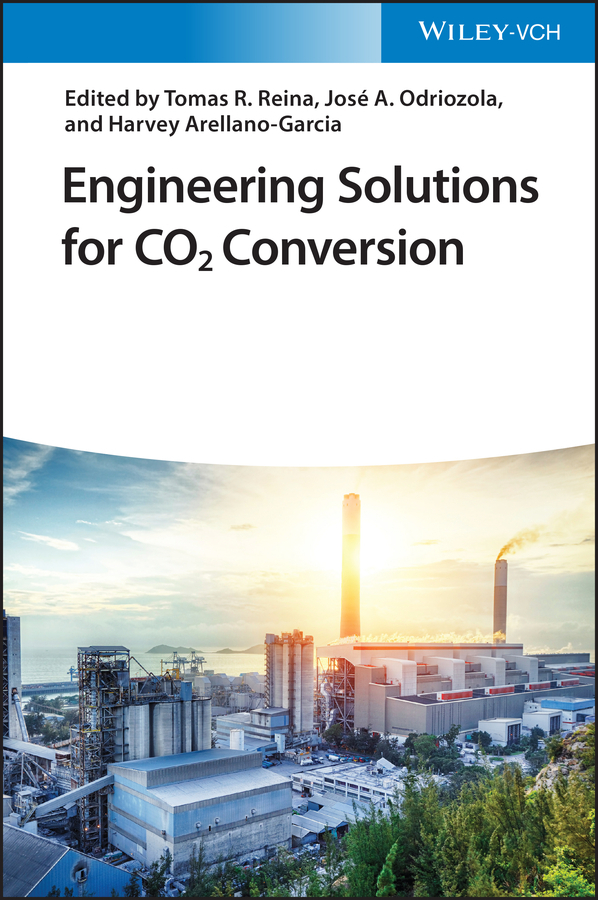
Engineering Solutions for CO2 Conversion
A comprehensive guide that offers a review of the current technologies that tackle CO2 emissions
The race to reduce CO2 emissions continues to be an urgent global challenge. Engineering Solutions for CO2 Conversion offers a thorough guide to the most current technologies designed to mitigate CO2 emissions ranging from CO2 capture to CO2 utilization approaches. With contributions from an international panel representing a wide range of expertise, this book contains a multidisciplinary toolkit that covers the myriad aspects of CO2 conversion strategies. Comprehensive in scope, it explores the chemical, physical, engineering and economical facets of CO2 conversion.
Engineering Solutions for CO2 Conversion explores a broad range of topics including linking CFD and process simulations, membranes technologies for efficient CO2 capture-conversion, biogas sweetening technologies, plasma-assisted conversion of CO2, and much more.
This important resource:
- Addresses a pressing concern of global environmental damage, caused by the greenhouse gases emissions from fossil fuels Contains a review of the most current developments on the various aspects of CO2 capture and utilization strategies
- Incldues information on chemical, physical, engineering and economical facets of CO2 capture and utilization
- Offers in-depth insight into materials design, processing characterization, and computer modeling with respect to CO2 capture and conversion
Written for catalytic chemists, electrochemists, process engineers, chemical engineers, chemists in industry, photochemists, environmental chemists, theoretical chemists, environmental officers, Engineering Solutions for CO2 Conversion provides the most current and expert information on the many aspects and challenges of CO2 conversion.
1 CO2 Capture - A Brief Review of Technologies and Its Integration 1
Mónica García, Theo Chronopoulos, and Rubén M. Montañés
1.1 Introduction: The Role of Carbon Capture 1
1.2 CO2 Capture Technologies 2
1.3 Integration of Post-combustion CO2 Capture in the Power Plant and Electricity Grid 17
1.4 CO2 Capture in the Industrial Sector 21
1.5 Conclusions 22
2 Advancing CCSU Technologies with Computational Fluid Dynamics (CFD): A Look at the Future by Linking CFD and Process Simulations 29
Daniel Sebastia-Saez, Evgenia Mechleri, and Harvey Arellano-García
2.1 Sweep Across the General Simulation Techniques Available 29
2.2 Multi-scale Approach for CFD Simulation of Amine Scrubbers 32
2.3 Eulerian, Eulerian-Lagrangian, and Discrete Element Methods for the Simulation of Calcium Looping, Mineral Carbonation, and Adsorption in Other Solid Particulate Materials 38
2.4 CFD for Oxy-fuel Combustion Technologies: The Application of Single-Phase Reactive Flows and Particle Tracking Algorithms 41
2.5 CFD for Carbon Storage and Enhanced Oil Recovery (EOR): The Link Between Advanced Imaging Techniques and CFD 41
2.6 CFD for Carbon Utilization with Chemical Conversion: The Importance of Numerical Techniques on the Study of New Catalysts 44
2.7 CFD for Biological Utilization: Microalgae Cultivation 46
2.8 What Does the Future Hold? 47
3 Membranes Technologies for Efficient CO2 Capture-Conversion 55
Sonia Remiro-Buenamañana, Laura Navarrete, Julio Garcia-Fayos, Sara Escorihuela, Sonia Escolastico, and José M. Serra
3.1 Introduction 55
3.2 Polymer Membranes 56
3.3 Oxygen Transport Membranes for CO2 Valorization 60
3.4 Protonic Membranes 65
3.5 Membranes for Electrochemical Applications 69
3.6 Conclusions and Final Remarks 78
4 Computational Modeling of Carbon Dioxide Catalytic Conversion 85
Javier Amaya Suárez, Elena R. Remesal, Jose J. Plata, Antonio M. Márquez, and Javier Fernández Sanz
4.1 Introduction 85
4.2 General Methods for Theoretical Catalysis Research 85
4.3 Characterizing the Catalyst and Its Interaction with CO2 Using DFT Calculations 87
4.4 Microkinetic Modeling in Heterogeneous Catalysis 89
4.5 New Trends: High-Throughput Screening, Volcano Plots, and Machine Learning 92
5 An Overview of the Transition to a Carbon-Neutral Steel Industry 105
Juan C. Navarro, Pablo Navarro, Oscar H. Laguna, Miguel A. Centeno, and José A. Odriozola
5.1 Introduction 105
5.2 Global Relevance of the Steel Industry 106
5.3 Current Trends in Emission Policies in the World's Leading Countries in Steel Industry 109
5.4 Transition to a Carbon-Neutral Production. A Big Challenge for the Steel Industry 110
5.5 CO2 Methanation: An Interesting Opportunity for the Valorization of the Steel Industry Emissions 114
5.6 Relevant Projects Already Launched for the Valorization of the CO2 Emitted by the Steel Industry 116
5.7 Concluding Remarks 119
6 Potential Processes for Simultaneous Biogas Upgrading and Carbon Dioxide Utilization 125
Francisco M. Baena-Moreno, Mónica Rodríguez-Galán, Fernando Vega, Isabel Malico, and Benito Navarrete
6.1 Introduction 125
6.2 Overview of Biogas General Characteristics and Upgrading Technologies to Bio-methane Production 127
6.3 CCU Main Technologies 131
6.4 Potential Processes for Biogas Upgrading and Carbon Utilization 133
6.5 Conclusions 138
7 Biogas Sweetening Technologies 145
Nikolaos D. Charisiou, Savvas L. Douvartzides, and Maria A. Goula
7.1 Introduction 145
7.2 Biogas Purification Technologies 146
7.3 Biogas Upgrading Technologies 157
7.4 Conclusions 166
8 CO2 Conversio
Anmelden
Ramirez Reina, Tomas
Odriozola, Jose A.
Arellano-Garcia, Harvey
| ISBN | 9783527346394 |
|---|---|
| Medientyp | Buch |
| Copyrightjahr | 2021 |
| Verlag | Wiley-VCH |
| Sprache | Englisch |