Vitreo-retinal Surgery
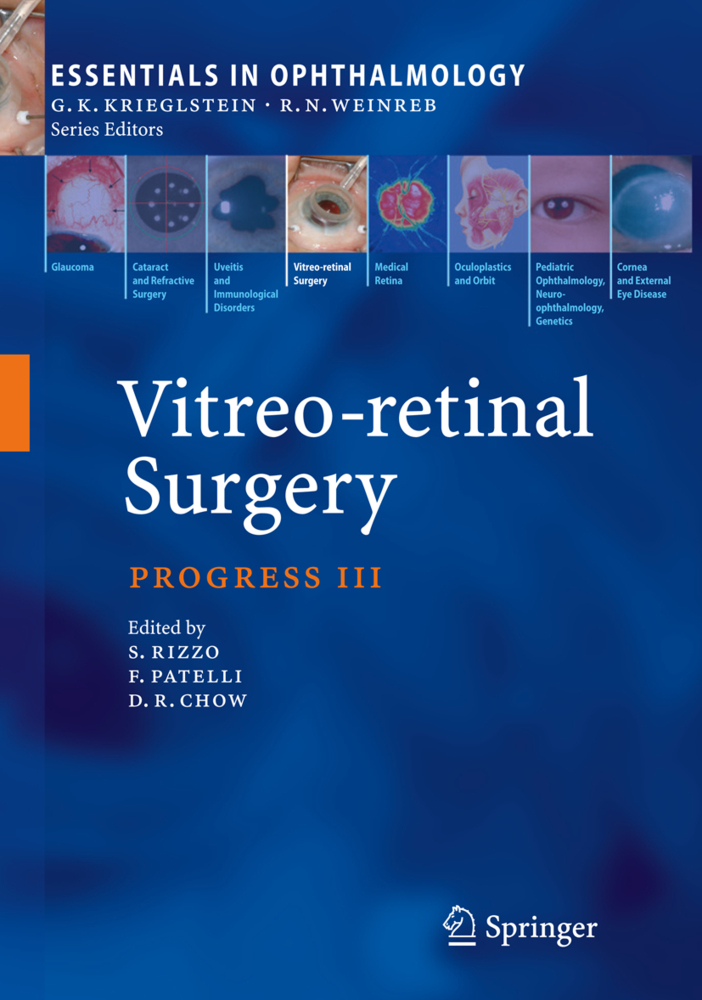
Vitreo-retinal Surgery
Since the introduction of vitrectomy in the 1970s, vitreoretinal surgery has rapidly developed. Initially, new instrumentations were created to facilitate intraocular maneuvers and to treat almost all the vitreoretinal pathologies. High speed vitrectome probs, forceps, scissors, endolaser probes, and new light sources (xenon/photon light) permit us to perform safer surgeries.
However, in the last few years the approach to vitreoretinal surgery has changed with the introduction of small gauge instruments and sutureless surgery. At present there is still confusion among vitreoretinal surgeons about the use of 25-, 23- or 20-gauge sutureless systems.
Leading surgeons in the field were recruited to offer their insights into the sutureless techniques they perform.
Topics dealt with in the book include: - fluidics and technical characteristics of 23- and 25-gauge systems, - basic vitrectomy techniques of 23- and 25-gauge systems, - sclerotomy characteristics of the sutureless approach, - advantages and disadvantages of the sutureless technique, - vitreoretinal pathologies treated with 23- and 25-gauge systems, - complications of the sutureless technique, - current clinical data.
Historical Overview of Microincision Surgery
25-Gauge Instrumentation: Engineering Challenges and Tradeoffs25-Gauge, Sutureless, Trans-Conjunctival Vitrectomy
Transconjunctival 23-Gauge Vitrectomy
23-Gauge One-Step Instrumentation
Small Gauge Vitrectomy: Anesthesia, Incision Technique and Cannula Removal
Comparison of 25-Gauge Trocar/Cannula Wound Healing and Remodeling with In Vivo Vitrector Flow Analysis
25-Gauge Vitreous Surgery: Getting Started
25-Gauge Macular Surgery: Principles and Instrumentations
25-Gauge Sutureless Vitrectomy for Diabetic Retinopathy
Small-Gauge Vitrectomy for Retinal Detachment
Perfluorocarbon-Perfused 25-Gauge Vitrectomy
Primary 25-Gauge Vitrectomy with Topical Anesthesia for Persistent Vitreous Floaters
25-Gauge Vitrectomy in Infectious Endophthalmitis
25-Gauge Transconjunctival Sutureless Vitrectomy for Vitreous and Retinal/Choroidal Biopsy
Uveal Biopsy with 25-Gauge Vitrector: Work in Progress
The Use of 25-Gauge Vitrectomy Systems in the Management of Trauma
Small-Gauge Approach in Pediatric Vitreoretinal Surgery
Combined Phaco/25-Gauge Vitrectomy
Complications of 25-Gauge Vitrectomy
A Comparison of 20- vs 25-Gauge Vitrectomy: Does Size Matter?
20-Gauge Sutureless Vitrectomy Trocar System
20-Gauge Non-Cannulated Sutureless Vitrectomy
Small-Gauge Vitrectomy: Which Calliper Should We Choose and When?
Current Clinical Data and Future (for Small-Gauge Vitreoretinal Surgery)
Pearls from Experts.
Anmelden
Rizzo, Stanislao
Patelli, Fabio
Chow, David
| ISBN | 978-3-642-08898-8 |
|---|---|
| Medientyp | Buch |
| Copyrightjahr | 2010 |
| Verlag | Springer, Berlin |
| Umfang | XVIII, 234 Seiten |
| Abbildungen | XVIII, 234 p. 50 illus., 31 illus. in color. |
| Sprache | Englisch |