Studying Vibrational Communication
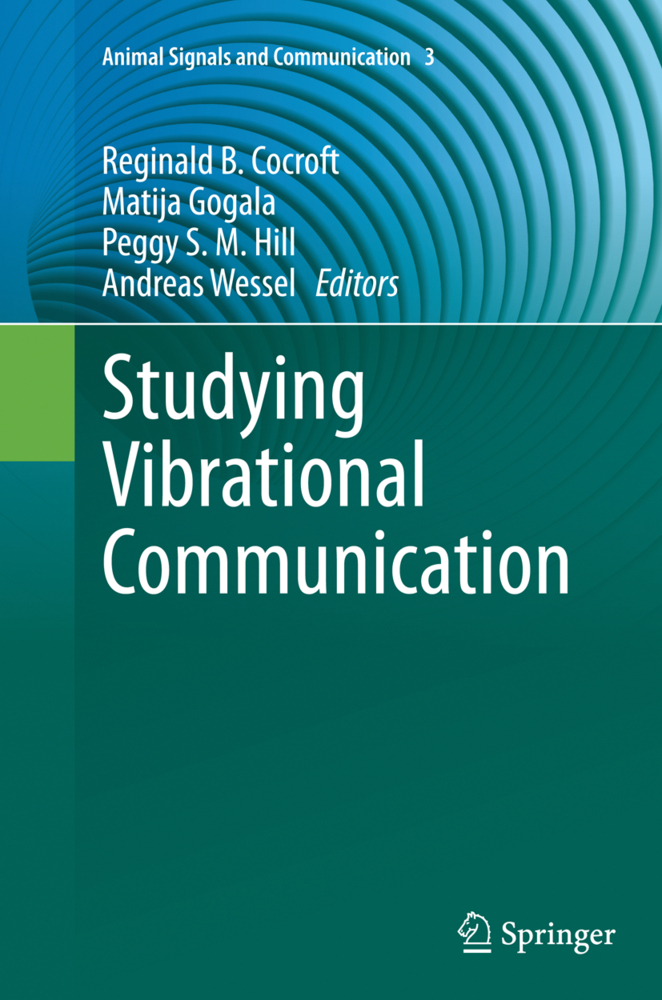
Studying Vibrational Communication
Fostering research progress in a rapidly growing field
Stretching the paradigm or building anew? Development of a cohesive language for vibrational communication
Sound or vibration, an old question in insect communication
Hildegard Strübing - a pioneer in vibrational communication research
Sound production - the crucial factor for mate finding in planthoppers (Homoptera - Auchenorrhyncha) (Preliminary communication), 1958
Interactions between airborne sound and substrate vibration in animal communication
Vibrational communication networks: eavesdropping and biotic noise
Active space and the role of amplitude in plant-borne vibrational communication
Mutual behavioral adjustment in vibrational duetting
Communication through plants in a narrow frequency window
Physical aspects of vibrational communication
The role of wave and substrate heterogeneity in vibratory communication: Practical issues in studying the role of vibratory environments in communication
Vibrational playback experiments: challenges and solutions
Functional morphology and evolutionary diversity of vibration receptors in insects
Echolocation in whirligig beetles using surface waves: an unsubstantiated conjecture
Sand-borne vibrations in prey detection and orientation of antlions
Mechanical signals in honeybee communication
Barth Vibratory communication in stingless bees (Meliponini). The challenge of interpreting the signals
The role of frequency in vibrational communication of Orthoptera
The tymbal - Evolution of a complex vibration-producing organ in the Tymbalia (Hemiptera excl. Sternorrhyncha).
Anmelden
Cocroft, Reginald B.
Gogala, Matija
Hill, Peggy S.M.
Wessel, Andreas
| ISBN | 978-3-662-50703-2 |
|---|---|
| Medientyp | Buch |
| Copyrightjahr | 2016 |
| Verlag | Springer, Berlin |
| Umfang | XV, 462 Seiten |
| Abbildungen | XV, 462 p. 108 illus., 28 illus. in color. |
| Sprache | Englisch |