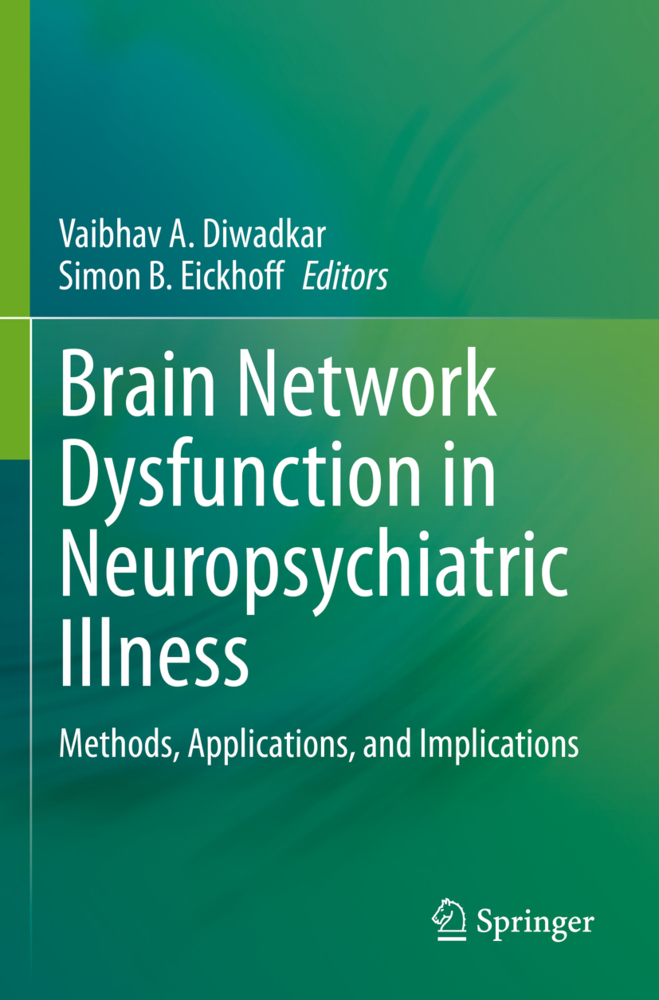
Brain Network Dysfunction in Neuropsychiatric Illness
Brain network function and dysfunction is the dominant model for understanding how the brain gives rise to normal and abnormal behavior. Moreover, neuropsychiatric illnesses continue to resist attempts to reveal an understanding of their bases. Thus, this timely volume provides a synthesis of the uses of multiple analytic methods as they are applied to neuroimaging data, to seek understanding of the neurobiological bases of psychiatric illnesses, understanding that can subsequently aid in their management and treatment. A principle focus is on the analyses and application of methods to functional magnetic resonance imaging (fMRI) data. fMRI remains the most widely used neuroimaging technique for estimating brain network function, and several of the methods covered can estimate brain network dysfunction in resting and task-active states.
Additional chapters provide details on how these methods are (and can be) applied in the understanding of several neuropsychiatric disorders, including schizophrenia, mood disorders, autism, borderline personality disorder, and attention deficit hyperactivity disorder (ADHD). A final complement of chapters provides a collective overview of how this framework continues to provoke theoretical advances in our conception of the brain in psychiatry. This unique volume is designed to be a comprehensive resource for imaging researchers interested in psychiatry, and for psychiatrists interested in advanced imaging applications.
1. Introduction
2. fMRI: Blood Oxygen Level Dependent Contrast and Its Value for Understanding Functioning Brain Networks3. Review of Resting-State Functional Connectivity Methods and Application in Clinical Populations
4. Directed Interregional Brain Interactions
5. Meta-analytic connectivity modelling (MACM): A tool for assessing regionspecific functional connectivity patterns in task-constrained states
6. dMRI: Diffusion Magnetic Resonance Imaging as a Window onto Structural Brain Networks and White Matter Microstructure
7. Data Mining in the Era of Big Data: The BrainMap Database as a Resource for Characterizing Psychiatric Illness
8. Network modulation in neuropsychiatric disorders using The Virtual Brain
9. Networks-mediated spreading of pathology in neurodegenerative diseases
10. Resting-State Functional Network Disturbances in Schizophrenia
11. Disturbed Brain Networks in the Psychosis High-Risk State?
12. Functional Connectivity in Autism Spectrum Disorders: Challenges and Perspectives
13. Functional Resting-State Network Disturbances in Bipolar Disorder
14. An overview of resting state functional connectivity studies of major depressive disorder
15. Brain network dysfunction in bipolar disorder: evidence from structural and functional MRI studies
16. Understanding the Network Bases of ADHD: An Overview of the fMRI Evidence
17. Cortical-Limbic and Default Mode Networks in Borderline Personality Disorder
18. Structural and Functional Connectivity Changes Following Cognitive Remediation: A systematic review
19. Single-Subject Prediction: A Statistical Paradigm for Precision Psychiatry
20. Genetic Imaging: Promises and Pitfalls
21. Brain networks and the emergence of the Self: A neurophenomenal perspective
22. Research Domains and Brain Network Dysfunction: Toward a New Taxonomy of Neuropsychiatric Illness.
Anmelden
Diwadkar, Vaibhav A.
B. Eickhoff, Simon
| ISBN | 978-3-030-59796-2 |
|---|---|
| Medientyp | Buch |
| Copyrightjahr | 2021 |
| Verlag | Springer, Berlin |
| Umfang | XVII, 488 Seiten |
| Abbildungen | XVII, 488 p. 79 illus., 72 illus. in color. |
| Sprache | Englisch |