Thermodynamics for Chemical Engineers
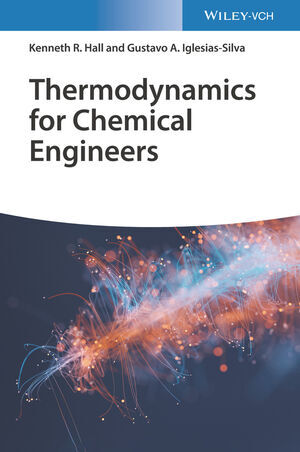
Thermodynamics for Chemical Engineers
Learn the basics of thermodynamics in this complete and practice-oriented introduction for students of chemical engineering
Thermodynamics is a vital branch of physics that focuses upon the interaction of heat, work, and temperature with energy, radiation, and matter. Thermodynamics can apply to a wide range of sciences, but is particularly important in chemical engineering, where the interconnection of heat and work with chemical reactions or physical changes of state are studied according to the laws of thermodynamics. Moreover, thermodynamics in chemical engineering focuses upon pure fluid and mixture properties, phase equilibrium, and chemical reactions within the confines of the laws of thermodynamics.
Given that thermodynamics is an essential course of study in chemical and petroleum engineering, Thermodynamics for Chemical Engineers provides an important introduction to the subject that comprehensively covers the topic in an easily-digestible manner. Suitable for undergraduate and graduate students, the text introduces the basic concepts of thermodynamics thoroughly and concisely while providing practice-oriented examples and illustrations. Thus, the book helps students bridge the gap between theoretical knowledge and basic experiments and measurement characteristics.
Thermodynamics for Chemical Engineers readers will also find:
* Practice-oriented examples to help students connect the learned concepts to actual laboratory instruments and experiments
* A broad suite of illustrations throughout the text to help illuminate the information presented
* Authors with decades working in chemical engineering and teaching thermodynamics
Thermodynamics for Chemical Engineers is the ideal resource not just for undergraduate and graduate students in chemical and petroleum engineering, but also for anyone looking for a basic guide to thermodynamics.
Chapter 1 Introduction
Learn the basics of thermodynamics in this complete and practice-oriented introduction for students of chemical engineering
Thermodynamics is a vital branch of physics that focuses upon the interaction of heat, work, and temperature with energy, radiation, and matter. Thermodynamics can apply to a wide range of sciences, but is particularly important in chemical engineering, where the interconnection of heat and work with chemical reactions or physical changes of state are studied according to the laws of thermodynamics. Moreover, thermodynamics in chemical engineering focuses upon pure fluid and mixture properties, phase equilibrium, and chemical reactions within the confines of the laws of thermodynamics.
Given that thermodynamics is an essential course of study in chemical and petroleum engineering, Thermodynamics for Chemical Engineers provides an important introduction to the subject that comprehensively covers the topic in an easily-digestible manner. Suitable for undergraduate and graduate students, the text introduces the basic concepts of thermodynamics thoroughly and concisely while providing practice-oriented examples and illustrations. Thus, the book helps students bridge the gap between theoretical knowledge and basic experiments and measurement characteristics.
Thermodynamics for Chemical Engineers readers will also find:
* Practice-oriented examples to help students connect the learned concepts to actual laboratory instruments and experiments
* A broad suite of illustrations throughout the text to help illuminate the information presented
* Authors with decades working in chemical engineering and teaching thermodynamics
Thermodynamics for Chemical Engineers is the ideal resource not just for undergraduate and graduate students in chemical and petroleum engineering, but also for anyone looking for a basic guide to thermodynamics.
Chapter 1 Introduction
Chapter 2 Energy and the 1st Law
Chapter 3 PVT Relations and Equations of State
Chapter 4 2nd Law of Thermodynamics
Chapter 5 Thermodynamic Relations
Chapter 6 Practical Applications of Thermodynamics
Chapter 7 Solution Theory
Chapter 8 Phase Equilibrium
Chapter 9 Chemical Reaction Equilibria
Anmelden
Hall, Kenneth R.
Iglesias-Silva, Gustavo A.
| ISBN | 9783527350308 |
|---|---|
| Medientyp | Buch |
| Auflage | 1. Auflage |
| Copyrightjahr | 2022 |
| Verlag | Wiley-VCH |
| Umfang | 480 Seiten |
| Abbildungen | 67 SW-Abb., 98 Farbabb. |
| Sprache | Englisch |