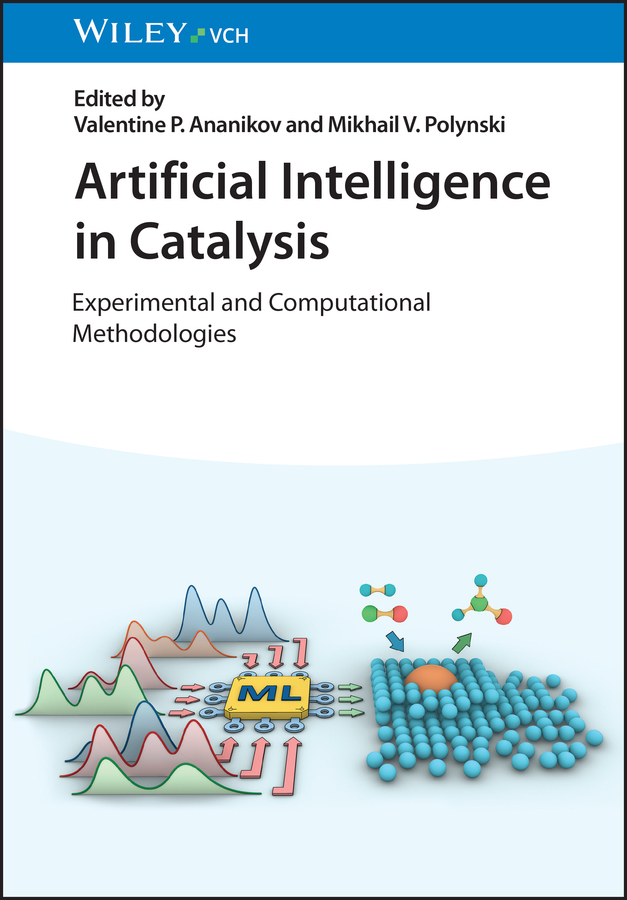
Artificial Intelligence in Catalysis
Enables researchers and professionals to leverage machine learning tools to optimize catalyst design and chemical processes
Artificial Intelligence in Catalysis delivers a state-of-the-art overview of artificial intelligence methodologies applied in catalysis. Divided into three parts, it covers the latest advancements and trends for catalyst discovery and characterization, reaction predictions, and process optimization using machine learning, quantum chemistry, and cheminformatics.
Written by an international team of experts in the field, with each chapter combining experimental and computational knowledge, Artificial Intelligence in Catalysis includes information on:
- Artificial intelligence techniques for chemical reaction monitoring and structural analysis
- Application of artificial neural networks in the analysis of electron microscopy data
- Construction of training datasets for chemical reactivity prediction through computational means
- Catalyst optimization and discovery using machine learning models
- Predicting selectivity in asymmetric catalysis with machine learning
Artificial Intelligence in Catalysis is a practical guide for researchers in academia and industry interested in developing new catalysts, improving organic synthesis, and minimizing waste and energy use.
Preface: Shaping the Future of Catalysis Research with Artificial Intelligence xi
Valentine P. Ananikov and Mikhail V. Polynski
Part I Machine Learning Applications in Structural Analysis and Reaction Monitoring 1
1 Computer Vision in Chemical Reaction Monitoring and Analysis 3
Marc Reid
1.1 Introduction 3
1.2 Fundamentals of Computer Vision in Chemistry 4
1.2.1 Color Theory 4
1.2.2 Digital Photography Basics 10
1.3 Computer Vision and Machine Learning in Chemistry 19
1.3.1 Single Image Applications 19
1.3.2 Video Analysis Applications 27
1.4 Summary and Conclusion 31
2 Machine Learning Meets Mass Spectrometry: A Focused Perspective 35
Daniil A. Boiko and Valentine P. Ananikov
2.1 Introduction 35
2.2 Mass Spectrometry in the Machine Learning Era 36
2.3 Mass Spectrometry Methods Landscape and Their Potential for Machine Learning Applications 38
2.4 Representative Mass Spectrometry Applications of Machine Learning 41
2.4.1 Sample Preparation 41
2.4.2 Data Acquisition 42
2.4.3 Data Preprocessing 43
2.4.4 Data Analysis 43
2.5 Protocol for Solving General Problems in Mass Spectrometry Using Machine Learning 45
2.5.1 Data Source 45
2.5.2 Spectra Representation 46
2.5.3 Algorithm Development 47
2.5.4 Metric Selection 48
2.6 Summary and Conclusion 48
3 Application of Artificial Neural Networks in the Analysis of Microscopy Data 55
Anna V. Matveev, Anna G. Okunev, and Anna V. Nartova
3.1 Introduction 55
3.2 Deep Machine Learning for Image Analysis 57
3.2.1 STM Image analysis 57
3.2.2 TEM Image Analysis 60
3.2.3 Comparison of Different Neural Networks 62
3.3 iOk Platform for Automatic Image Analysis 62
3.3.1 Web-service ParticlesNN 63
3.3.2 Chat Bot DLgram 65
3.3.3 No Code ML 68
3.3.4 Comparison of iOk Platform Services with Other Products 70
3.4 Analysis of TEM Images of Heterogeneous Catalyst by iOk Platform 71
3.4.1 Automated Analysis of Supported Catalyst TEM Images 71
3.4.2 High-resolution TEM Images 72
3.4.3 Single Site Analysis 74
3.5 Practical Summary 76
3.6 Future Prospects 77
3.7 Acknowledgments 78
Part II Quantum Chemical Methods Meet Machine Learning 81
4 Construction of Training Datasets for Chemical Reactivity Prediction Through Computational Means 83
Thijs Stuyver and Javier Alfonso-Ramos
4.1 Introduction 83
4.2 Oracle Design 84
4.2.1 Compute Time - Accuracy Trade-off 85
4.2.2 Implications of Optimizing for Multiple Criteria Simultaneously 87
4.2.3 Benchmarking 88
4.2.4 Reproducibility 90
4.3 Sampling the Search Space 91
4.4 Active Learning Strategies 93
4.5 Automation Software for Accelerated Oracle Design 94
4.5.1 autodE 94
4.5.2 RMSD-PP-TS 95
4.5.3 TS-tools 97
4.6 Summary and Conclusion 99
5 Machine Learned Force Fields: Fundamentals, Their Reach, and Challenges 105
Carlos A. Vital-José, Román J. Armenta-Rico and Huziel E. Sauceda
5.1 Introduction 105
5.2 Fundamentals of Machine Learning 107
5.3 Introduction to Neural Networks 110
5.3.1 The Perceptron 110
5.3.2 Multilayer Perceptron 112
5.3.3 The Architecture of a Neural Network 112
5.3.4 Optimization Algorithms 113
5.4 Introduction to Kernel Methods 114
5.5 Machine Learning in Chemical Reactions and Catalysis 115
5.5.1 Selectivity Prediction 116
5.5.2 Catalyst Design and Discovery 116
5.5.3 Experimental Condition Optimizations 117
5.5.4 Active Site Determination 117
5.6 Overview and Trends in MLFFs 118
5.6.1 Neural Network-based FF 118
5.6.2 Kernel-based FF 119
5.7 Neural Network-based Force Fields: The SchNet Case 120
5.7.1 Atom-type Embeddings 120
Anmelden
Ananikov, Valentine P.
Polynski, Mikhail V.
| ISBN | 9783527353859 |
|---|---|
| Medientyp | Buch |
| Copyrightjahr | 2025 |
| Verlag | Wiley-VCH |
| Umfang | 272 Seiten |
| Sprache | Englisch |