The Permutation Group in Physics and Chemistry
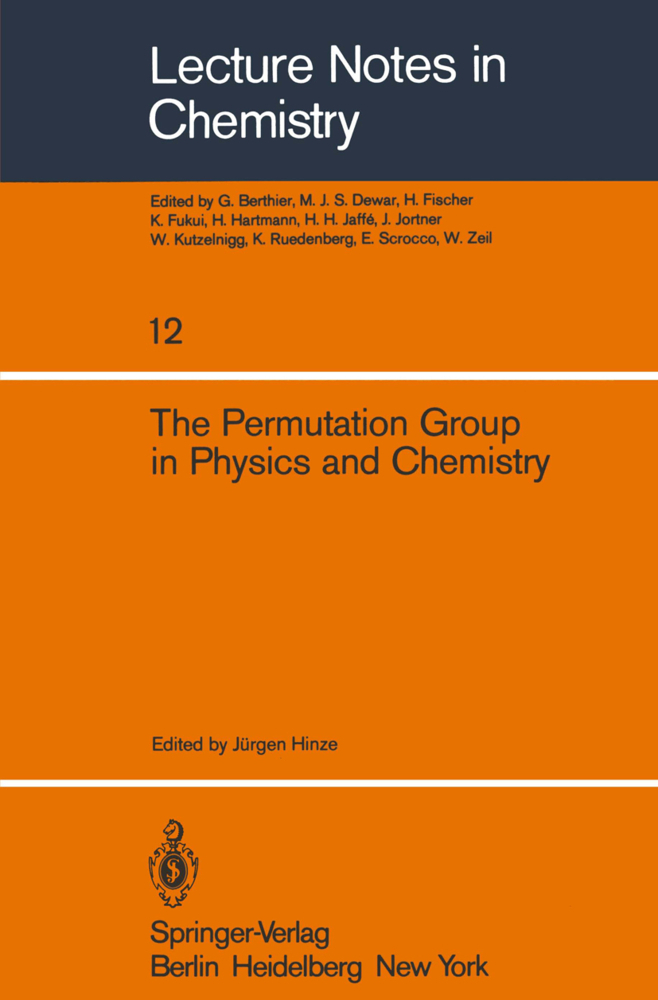
The Permutation Group in Physics and Chemistry
The permutation group has gained prominence in the fundamental research in diverse areas of physics and chemistry. Covering all salient developments of the last few years in a single symposium would require weeks, legions of participants and parallel sessions, highlighting the differences in language and communication problems between pure mathematicians, high and low energy physicists and chemists. The symposium held July 1978 at the Centre of Interdisciplinary Studies of the University of Bielefeld focussed on a small area, the pertinence of the permutation group in chemical physics, with the goal to increase and generate a fruitful dialogue between mathe maticians and chemists. In chemistry, concerned with the electronic and geometric structure of molecules as well as elementary chemical reactions, i.e. rearrangements in these structures, the permutation group has its relevance, since with its representations the effects and consequences of exchanging indistin guishable particles, electrons and identical nuclei, can be systematized and classified. This may be exemplified by a brief survey of the lectures presented, which may also serve as a first orientation· to the articles of this volume. In the first two contributions by A. Kerber and J.G. Nourse, the permutation group is used in the counting and systemtaic generation of stereoisomers aiding in the elucidation of possible molecular structures. The dynamics of stereochemistry is considered in the next article by J.G.
3. Applications of the Permutation Group in Dynamic Stereochemistry
4. The Spin Double Groups of Molecular Symmetry Groups
5. Relationship Between the Feasable Group and the Point Group of a Rigid Molecule
6. Some Suggestions Concerning a Geometric Definition of the Symmetry Group of Non-Rigid Molecules
7. Symmetry and Thermodynamics from Structured Molecules to Liquid Drops
8. Representations of the Symmetric Group as Special Cases of the Boson Polynomials in U(n)
9. The Permutation Group and the Coupling of n Spin- 1/2 Angular Momenta
10. The Permutation Group in Atomic Structure
11. Double Cosets and the Evaluation of Matrix Elements
12. Properties of Double Cosets with Applications to Theoretical Chemistry
13. The Chirality Algebra; some comments concerning mathematical aspects of the Ruch/Schönhofer chirality theory.
1. Counting Isomers and Such
2. Application of the Permutction Group to the Stereoisomer Generation for Computer Assisted Structure Elucidation3. Applications of the Permutation Group in Dynamic Stereochemistry
4. The Spin Double Groups of Molecular Symmetry Groups
5. Relationship Between the Feasable Group and the Point Group of a Rigid Molecule
6. Some Suggestions Concerning a Geometric Definition of the Symmetry Group of Non-Rigid Molecules
7. Symmetry and Thermodynamics from Structured Molecules to Liquid Drops
8. Representations of the Symmetric Group as Special Cases of the Boson Polynomials in U(n)
9. The Permutation Group and the Coupling of n Spin- 1/2 Angular Momenta
10. The Permutation Group in Atomic Structure
11. Double Cosets and the Evaluation of Matrix Elements
12. Properties of Double Cosets with Applications to Theoretical Chemistry
13. The Chirality Algebra; some comments concerning mathematical aspects of the Ruch/Schönhofer chirality theory.
Anmelden
Hinze, J.
| ISBN | 978-3-540-09707-5 |
|---|---|
| Medientyp | Buch |
| Copyrightjahr | 1979 |
| Verlag | Springer, Berlin |
| Umfang | VI, 230 Seiten |
| Abbildungen | VI, 230 p. |
| Sprache | Englisch |