Why Development Finance Creates Different Outcomes
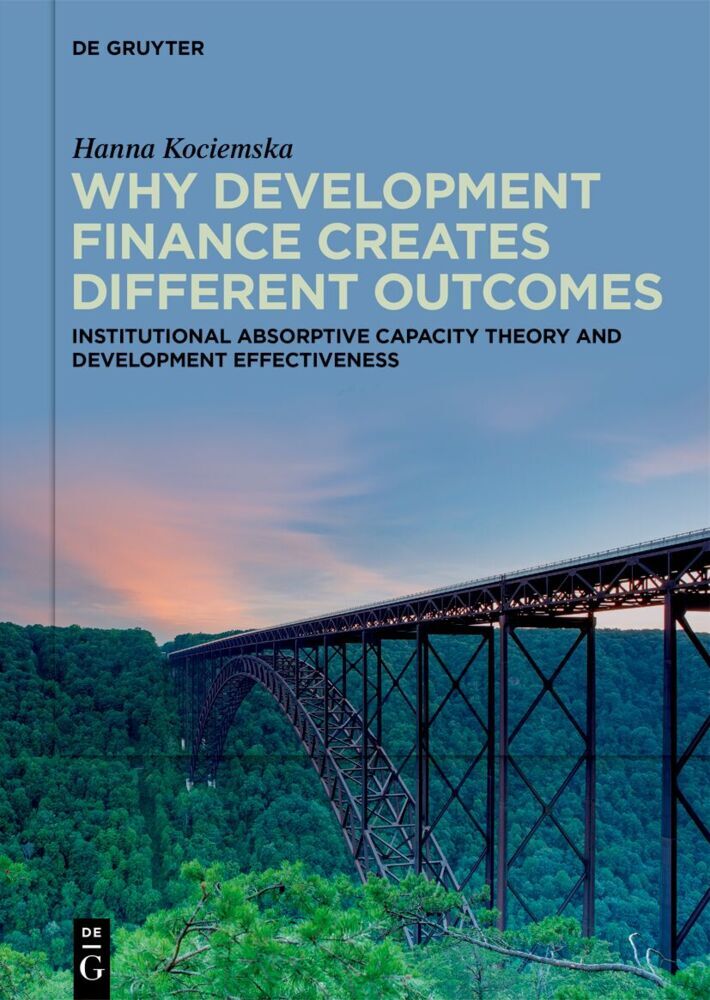
Why Development Finance Creates Different Outcomes
The book addresses a deceptively simple question with major implications for contemporary development research and policy: why do countries operating within broadly comparable development-finance architectures continue to achieve markedly different outcomes in human development, inequality, multidimensional poverty and environmental performance? Governments, multilateral development banks, development finance institutions and private investors have expanded the range and scale of resources available for sustainable development, yet the expansion of finance has not
produced a corresponding convergence in development outcomes.
The book argues that this divergence is not merely an implementation problem but a theoretical problem. Development Economics explains objectives and structural transformation; Institutional Economics establishes why institutions matter; Political Economy highlights governance and state capability; Sustainable Development Finance explains how resources can be mobilised. These traditions are individually powerful but do not provide an integrated explanation of the institutional process through which financial resources become durable multidimensional outcomes. The book terms this
the Development Effectiveness Paradox.
The central aim is to shift the analytical focus from financial mobilisation to development effectiveness. Financial capital is treated as developmental potential rather than development in itself. Its developmental value depends on institutional systems able to recognise opportunities, integrate resources, coordinate heterogeneous actors, implement policy, generate institutional learning and adapt governance arrangements. The book conceptualises this dynamic capability as Institutional Absorptive Capacity and develops Institutional Absorptive Capacity Theory (IACT) as a mechanism-based
middle-range theory.
The project builds on more than two decades of the author's research across Public Finance, Public-Private Partnerships, Sustainable Development Finance, governance, human development and institutional analysis, including the Springer monograph Public-Private Partnership for Sub-Saharan Africa (2019). Its contribution is threefold: it reframes development finance around development effectiveness; develops an original mechanism-based institutional theory connecting finance with multidimensional outcomes; and subjects the framework to a transparent empirical evaluation
reporting both supportive and non-supportive evidence. The result is an interdisciplinary research monograph on the institutional transformation of financial capital into sustainable public value.
Anmelden
Kociemska, Hanna
| ISBN | 9783112283981 |
|---|---|
| Medientyp | Buch |
| Copyrightjahr | 2027 |
| Verlag | De Gruyter |
| Abbildungen | 10 ill., 35 tbl. |
| Sprache | Englisch |