Inorganic Chemistry in Tables
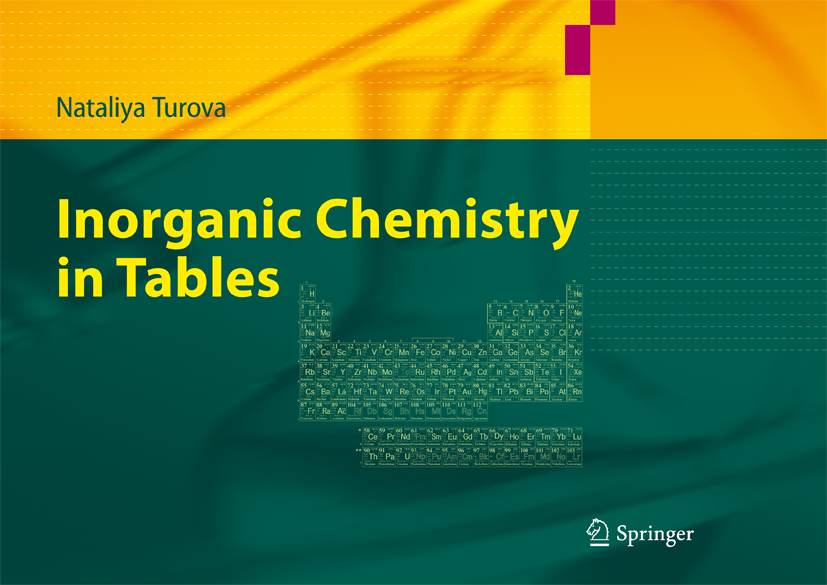
Inorganic Chemistry in Tables
The present supplement to Inorganic Chemistry courses is developed in the form of reference schemes, presenting the information on one or several related element derivatives and their mutual transformations within one double-sided sheet. The compounds are placed from left to right corresponding to the increase in the formal oxidation number of the element considered. For each distinct oxidation state the upper position in the column is occupied by an oxide, its hydrated forms, followed then by basic (and oxo-) and normal salts. The position of each compound in this scheme is unambiguously determined in this approach by the central atom oxidation number (in the horizontal direction) and the nature of ligand (in the vertical one), which simplifies considerably the search for necessary information. The mutual transformations are displayed by arrows accompanied by the reagents or other factors responsible for the reaction (red arrows mean oxidation, green arrows mean reduction, black arrows - if the oxidation number is not changed). Modern training programs require the mastering of a tremendous amount of data. The present tables should serve as a useful addition to textbooks and lectures.
Introduction
Halogens (F, Cl, Br, I, At)Chalcogens (O, S, Se, Te, Po)
Group VI (Cr, Mo, W)
Uranium, transuranium elements
Group V (N, P, As, Sb, Bi)
GroupVb (V, Nb, Ta, Pa)
Group IV (C, Si, Ge, Sn, Pb)
Group IVb (Ti, Zr, Hf)
Group III (B, Al, Ga, In, Tl)
Group IIIb (Sc, Y, La, Ac), lanthanides
Alkaline earth metals
Group IIb (Zn, Cd, Hg)
Alkaline metals
Group Ib (Cu, Ag, Au)
Group VIIIb (Fe, Co, Ni, Ru, Os, Rh, Ir, Pa, Pt).
Turova, Nataliya
| ISBN | 978-3-642-20486-9 |
|---|---|
| Medientyp | Buch |
| Copyrightjahr | 2011 |
| Verlag | Springer, Berlin |
| Umfang | IV, 157 Seiten |
| Sprache | Englisch |