Perovskite Light Emitting Diodes
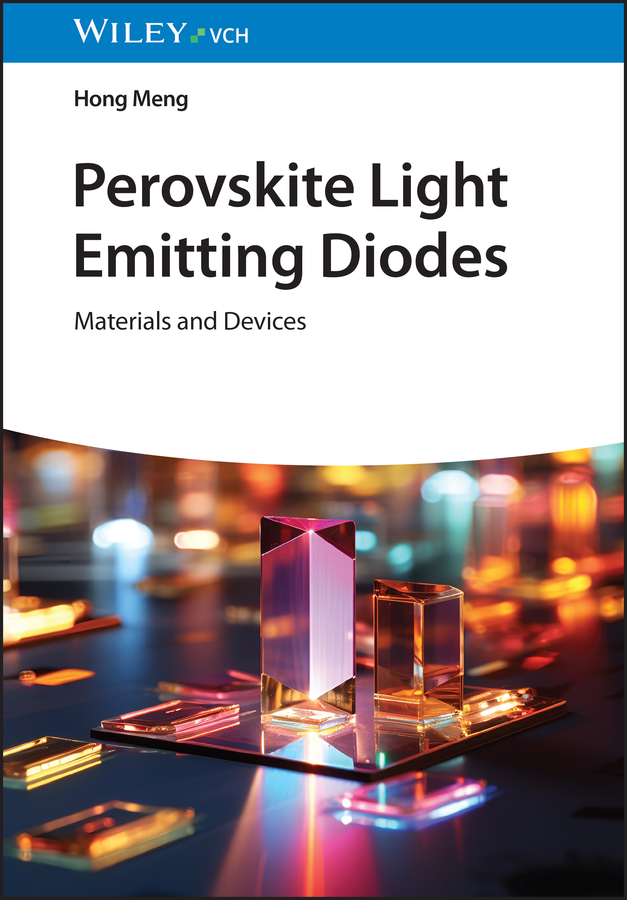
Perovskite Light Emitting Diodes
An introduction to revolutionary display technology
Perovskite Light Emitting Diodes, commonly referred to as Pe-LEDs, leverage a perovskite nanocrystal core to engender a luminous and efficient diode, holding the potential to bring about a paradigm shift in the realm of display technology. In recent times, Pe-LEDs have garnered substantial industrial interest due to their intrinsic capability to exhibit a diverse array of colors with exceptional fidelity, their operation at low voltage thresholds, and their straightforward structural composition. The prospective implications for enabling cost-effective, heightened-performance flat-panel displays as well as flexible display solutions remain notably profound.
Perovskite Light Emitting Diodes: Materials and Devices presents a comprehensive and insightful overview of these diodes and their multifaceted applications. Commencing with an incisive exploration of the historical trajectory of this technology, alongside a delineation of its foundational materials and intricate device architectures, this compendium provides a gateway into both contemporaneous state-of-the-art deployments and the vanguard of ongoing research endeavors directed towards charting future advancements.
Perovskite Light Emitting Diodes readers will also find:
- Stability analysis for different Pe-LED devices, a key aspect of creating physical displays
- Authorship by an established expert in organic electronics
- Detailed discussion of perovskite preparation methods including ultrasonic, solvent heat, thermal injection, and many more
Perovskite Light Emitting Diodes is ideal for materials scientists, electrical engineers, solid state chemists, solid state physicists, inorganic chemists, and any researchers or engineers working with display technology.
Preface xi
1 Structure and Physical Properties of Metal Halide Perovskites 1
1.1 Crystal Structure of Perovskite Materials 1
1.2 Exciton Effects in Perovskite Materials 2
1.2.1 Definition of an Exciton 2
1.2.2 Self-Trapping Excitons in Perovskite Materials 3
1.3 Size Effect of Perovskite Materials 5
1.4 Luminescence Properties of Perovskite Materials 7
1.4.1 Photon Generation in Perovskite Materials 8
1.4.2 Photophysical Processes and Efficiency Calculations of Perovskite Luminescence 10
1.4.3 Non-radiative Combination Mechanisms at Surfaces and Interfaces 13
1.5 Factors Influencing the Efficiency of Perovskite Light Emitting Diodes 16
1.5.1 Device Structure of the Perovskite Light Emitting Diode 16
1.5.2 Physical Parameters of Perovskite Light-Emitting Diodes 18
1.5.3 Device Performance Development of Perovskite Light-Emitting Diodes 20
1.6 Summary 23
2 Synthesis and Preparation of Perovskite Materials 35
2.1 Introduction 35
2.2 Perovskite Materials Structures 36
2.2.1 3D Halide Perovskite Materials for Light-Emitting Diodes 36
2.2.2 Layered Halide Perovskite Materials 36
2.2.3 Halide Perovskite Quantum Dots/Nanocrystals 40
2.2.4 Commercial Prospects of Perovskite Materials 43
2.3 Preparation of Perovskite Nanomaterials 46
2.3.1 Mechanochemical Method 46
2.3.2 Ultrasonic Method 47
2.3.3 Microwave Method 49
2.3.4 Solvent Heat Method 50
2.3.5 Thermal Injection Method 51
2.3.6 Ligand-Assisted Reprecipitation 60
2.3.7 Ion Exchange Method 67
2.3.8 Laser Etching Method 68
2.4 Processing Technology for Large-Area Perovskite Films 69
2.4.1 Spin Coating Method 69
2.4.2 Vacuum Thermal Vapor Deposition Method 70
2.4.3 Printing Method 71
2.4.4 Vapor -Phase Deposition Method 71
2.4.5 Spraying Method 74
2.4.6 Template Method 75
2.4.7 Non-Template Method 75
2.5 Conclusion and Outlook 76
3 Near-Infrared Perovskite Light-Emitting Devices 83
3.1 Introduction 83
3.2 Progress in Near-Infrared Perovskite Luminescence Materials 84
3.3 Near-Infrared Perovskite Luminescent Materials 86
3.3.1 Methylamine Lead Iodide (MAPbI3) 86
3.3.2 NIR-Emitting Materials Based on Perovskite 88
3.4 Strategies to Improve the Performance of NIR Perovskite Devices 90
3.4.1 NIR Perovskite Material Optimization 91
3.4.1.1 Near-InfraredWavelength Adjustment 91
3.4.1.2 Multiple QuantumWell Structure 94
3.4.1.3 Molecular Passivation 95
3.4.2 Device Structure Optimization 96
3.5 Conclusion and Outlook 98
4 Perovskite Red Light-Emitting Materials and Devices 103
4.1 The Development History of Perovskite Red Light-Emitting Diodes 103
4.2 Red Emission Perovskite Materials 105
4.2.1 Typical Red Emission Perovskite Material CsPbI3 105
4.2.2 Other Red Emission Perovskite Materials 107
4.2.2.1 Other ABX3 and Hybridized ABX3-Type Materials 107
4.2.2.2 Double Perovskite 110
4.2.3 Red Emission Perovskite Synthesis 111
4.2.3.1 Synthesis of Nanocrystals 111
4.2.3.2 Synthesis of Quasi-Two-Dimensional Films 112
4.2.4 Optimization Strategies of Red Perovskite Materials 113
4.2.4.1 Doping 113
4.2.4.2 Surface Passivation 114
4.2.4.3 Multiple QuantumWell Structure 115
4.2.4.4 Ligand Engineering 116
4.2.4.5 Additive Engineering 117
4.3 Perovskite Red Light-Emitting Diodes 117
4.3.1 Device Structure and Common Materials for Each Functional Layer 117
4.3.2 Device Optimization Strategy 118
4.3.2.1 Energy Level Regulation 119
4.3.2.2 Light Extraction Technology 119
4.3.2.3 Interface Treatment Method 119
4.4 Conclusion and Outlook 120
Anmelden
Meng, Hong
| ISBN | 9783527353200 |
|---|---|
| Medientyp | Buch |
| Copyrightjahr | 2024 |
| Verlag | Wiley-VCH |
| Umfang | 368 Seiten |
| Sprache | Englisch |