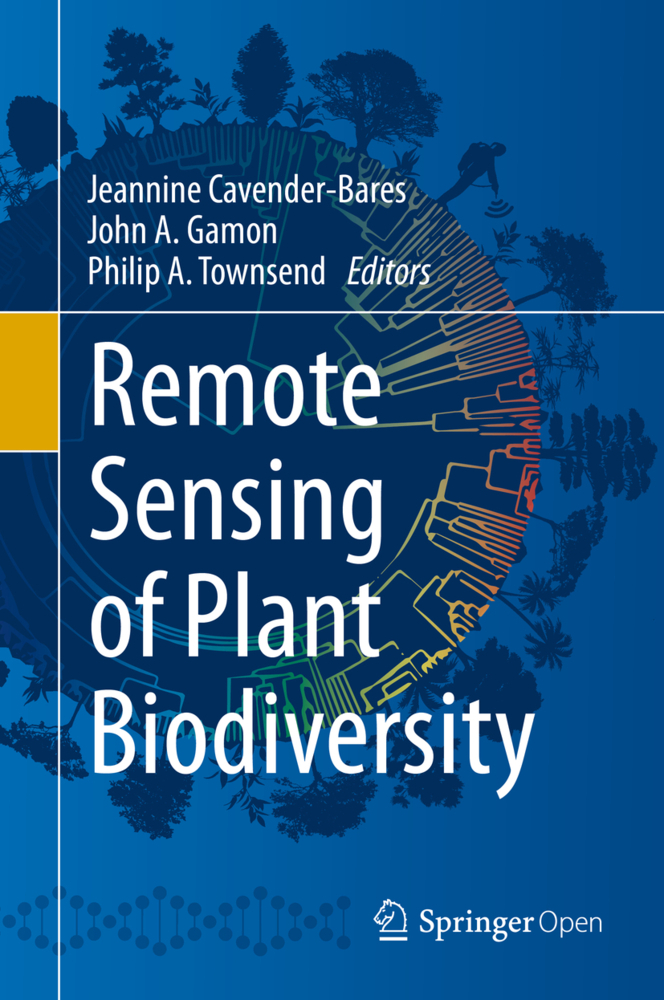
Remote Sensing of Plant Biodiversity
Remote Sensing of Plant Biodiversity
This Open Access volume aims to methodologically improve our understanding of biodiversity by linking disciplines that incorporate remote sensing, and uniting data and perspectives in the fields of biology, landscape ecology, and geography. The book provides a framework for how biodiversity can be detected and evaluated-focusing particularly on plants-using proximal and remotely sensed hyperspectral data and other tools such as LiDAR. The volume, whose chapters bring together a large cross-section of the biodiversity community engaged in these methods, attempts to establish a common language across disciplines for understanding and implementing remote sensing of biodiversity across scales.
The first part of the book offers a potential basis for remote detection of biodiversity. An overview of the nature of biodiversity is described, along with ways for determining traits of plant biodiversity through spectral analyses across spatial scales and linking spectral data to the tree of life. The second part details what can be detected spectrally and remotely. Specific instrumentation and technologies are described, as well as the technical challenges of detection and data synthesis, collection and processing. The third part discusses spatial resolution and integration across scales and ends with a vision for developing a global biodiversity monitoring system. Topics include spectral and functional variation across habitats and biomes, biodiversity variables for global scale assessment, and the prospects and pitfalls in remote sensing of biodiversity at the global scale.
Chapter1. The use of remote sensing to enhance biodiversity monitoring & detection-a critical challenge for the 21st century. - Chapter2. Applying Remote Sensing to Biodiversity Science
Chapter3. Scaling Functional Traits from Leaves to Canopies
Chapter4. The Laegeren Site: An Augmented Forest Laboratory
Chapter5. Lessons Learned from Spectranomics: Wet Tropical Forests
Chapter6. Remote Sensing for Early, Detailed, and Accurate Detection of Forest Disturbance and Decline for Protection of Biodiversity
Chapter7. Linking Leaf Spectra to the Plant Tree of Life
Chapter8. Linking Foliar Traits to Belowground Processes
Chapter9. Linking Foliar Traits to Belowground Processes
Chapter9. Using Remote Sensing for Modeling and Monitoring Species Distributions
Chapter10. Remote Sensing of Geodiversity as a Link to Biodiversity
Chapter11. Predicting Patterns of Plant Diversity and Endemism in the Tropics Using Remote Sensing Data: A Study Case From the Brazilian Atlantic Forest
Chapter12. Remote Detection of Invasive Alien Species
Chapter13. A Range of Earth Observation Techniques for Assessing Plant Diversity
Chapter14. How the Optical Properties of Leaves Modify the Absorption and Scattering of Energy and Enhance Leaf Functionality
Chapter15. Spectral Field Campaigns: Planning and Data Collection
Chapter16. Consideration of Scale in Remote Sensing of Biodiversity
Chapter17. Integrating Biodiversity, Remote Sensing, and Auxiliary Information for the Study of Ecosystem Functioning and Conservation at Large Spatial Scales
Chapter18. Essential Biodiversity Variables: Integrating in Situ Observations and Remote Sensing Through Modeling
Chapter19. Prospects and pitfalls for spectroscopic remote sensing of biodiversity at the global scale
Chapter20. Epilogue - Towards a Global Biodiversity Monitoring System.
Anmelden
Cavender-Bares, Jeannine
Gamon, John A.
Townsend, Philip A.
| ISBN | 978-3-030-33159-7 |
|---|---|
| Medientyp | Buch |
| Auflage | 1st ed. 2020 |
| Copyrightjahr | 2020 |
| Verlag | Springer, Berlin |
| Umfang | XXII, 581 Seiten |
| Abbildungen | XXII, 581 p. 130 illus., 110 illus. in color. |
| Sprache | Englisch |